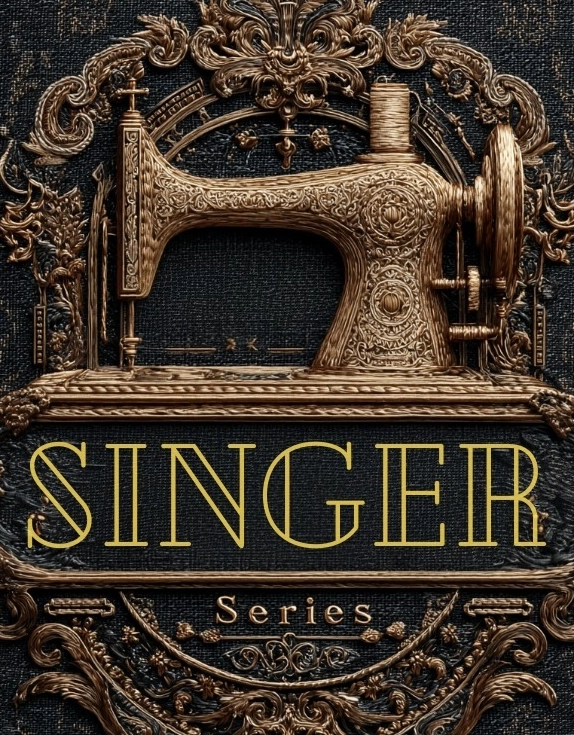

The gold letters spelling SINGER have been seen in nearly every corner of the inhabited world. They were stamped in Cyrillic in St. Petersburg, Arabic in Cairo, kanji in Kyoto. The sewing machine they sat on traveled with the kind of confidence usually reserved for national flags.
Everyone knows the brand.
Almost no one remembers the man whose name it is. That's not an accident. His own partners worked very hard to scrub the face of "the scoundrel" out of company advertising, faster than they got his body out of the 115-room English country house where he died in 1875.
Meet Isaac Merritt Singer. Eighth child of German-Dutch immigrants. Failed Shakespearean actor. Bigamist with four parallel households and more than two dozen children. The man who didn't love the thing that changed the world.
A giant with a provincial Hamlet's voice
Six foot five. About 196 centimeters. In the mid-19th century that was almost a deformity. Reddish-blond beard, shoulders cut for plowing or stage combat, a voice trained to fill two hundred seats.
He'd trained that voice for years. Before he was an industrialist, Isaac Singer was a touring actor, running his own outfit — the Merritt Players — under the stage name "Isaac Merritt." Shakespeare in rural Ohio halls. Richard III in half-empty Pennsylvania halls. Hamlet to audiences who paid in copper coins and slipped out before the second act.
At twelve he ran from home. From Oswego, on the shore of Lake Ontario, where his German father had remarried and the new wife had decided her stepson was a burden. Sixty miles west on foot, to an older brother's machine shop. Then evening school at the Mechanics' Society, by the stub of a candle, finger tracing letters in a primer. By fifteen he could read.
By forty he had nothing the world had promised him.
A hunger you couldn't feed
The engine inside Isaac wasn't greed. Greed was the symptom. The engine was the fear of disappearing.
His biographer Ruth Brandon puts it without mercy: he had, she writes, "an insatiable need for attachment to women" — and underneath the lust, a craving for the family he'd never had. Four households in one city wasn't libertinism in the simple sense. This was a man whose mother walked out when he was ten, whose father looked away, and who was now filling the world with himself the way you fill a hole in the ground. Each child a flag staked in territory.
Twenty-four children. He acknowledged and supported every one.
When Orson Phelps's Boston workshop showed him a misbehaving Lerow & Blodgett sewing machine in 1850, Isaac's first reaction was contempt: "What a devilish machine! You want to do away with the only thing that keeps women quiet, their sewing!" But the moment money entered the conversation, he delivered the line that became the diagnosis of his entire personality:
I don't give a damn for the invention. The dimes are what I am after.
Not a pose. A confession.
Eleven days that rewrote a century
September 1850. Phelps's shop, 19 Harvard Place, Boston. Three thousand dollars borrowed from George Zieber and Phelps. Isaac sat down at the bench.
Eleven days later the bench held the first practical sewing machine in history. A straight-line shuttle instead of a circular one. A vertical needle. A presser foot to hold the cloth. A foot treadle that, for the first time in human history, freed a woman's hands from her sewing.
He hadn't invented the sewing machine. People had been trying for thirty years. What he did, nobody else had managed: he turned a tinkerer's idea into an industry. And he did it for the dimes, not for the cause.
What came next is the part Harvard Business School ought to teach. Installments at five dollars a month instead of $125 cash — the first national consumer-credit plan in American history. Marble-and-gilt showrooms on Broadway with live demonstrators, a century and a half before Apple Stores. Trade-in programs in which competitors' old machines were publicly destroyed. The first global patent pool. Factories in Scotland, France, and a Russian town outside Moscow. A canary-yellow carriage that seated thirty-one, in which Isaac paraded down Fifth Avenue while polite New York winced at the vulgarity.
In parallel: four families, a flight to Europe under the false name Simmons, a bigamy scandal in the press, and a fortune of thirteen million dollars at his death.
What the world got
He died in England, in his country pile, never knowing the most important thing.
Never knowing that Russian women would start calling his machine Zina — a woman's name, the way you'd name a stove or an old car you trust. That during the Second World War, when men were at the front, Zina would be the only thing keeping millions of households from starving. That in besieged Leningrad, sixty-six years after he was buried, a woman with a daughter on her lap would look at the black machine with the gold letters as the only thing standing between them and winter.
Never knowing that his daughter Winnaretta would become Princesse Edmond de Polignac and use his sewing-machine money to commission Ravel, Fauré, Stravinsky, Satie.
That millions of women around the world would claw back roughly thirteen free hours a day from history — because one scoundrel in a Boston workshop didn't want to die poor.
The honest revolutions tend to happen by accident.
Why we're telling this story
In August 2026, Singer's patent turns 175. To mark the date, the first full-length literary biography of Isaac Singer is being published — narrative biography in the tradition of Ron Chernow, Erik Larson, Walter Isaacson, where the documentary record is bedrock and the scenes are built on top of it. No hagiography. No apologies. No convenient silences.
This blog is the road there. We'll get to the man Isaac betrayed first — the only person who'd ever believed in him. We'll get to Edward Clark, the lawyer with the Sunday-school face who actually ran the empire while the scoundrel was abroad running from it. We'll get to why Isaac's eldest son inherited exactly five hundred dollars out of thirteen million.
And we'll get to what's left of Singer today: in museums, in family attics, in tailor shops from Lagos to Lahore, in heirlooms that get passed from grandmother to granddaughter, still stitching.
The story is just beginning.
Subscribe to the Singer Series newsletter — get the first chapter of the book before publication, free.