
Yury Boldyrev, 47
Author · Screenwriter
I am a husband and the father of five children. I draw inspiration from history, nature, and the quiet dignity of manual work. As a writer and screenwriter, I strive to create precise and deeply grounded stories that capture the living texture of an era and the enduring connection between generations. Above all, I hope to leave behind work that can serve as a meaningful reference point for my children and future generations.
Full Biography
For interviews, guest publications, long-form press.
This story wasn't found in archives. It came out of Yury's own childhood. He simply saw his grandmother's sewing machine at home: black cast iron, the word SINGER in gold lettering.
His great-grandmother received that machine in tsarist Russia in the early twentieth century. It was passed down through three generations and remained in the family for nearly a hundred years. Yury’s grandmother used to say it had carried the family through two world wars, and she meant it literally: there were times when the presence of that machine and the ability to sew decided whether the family ate that day. They called it Zina — like a member of the family.
When Yury first asked who Singer was, no one could tell him much beyond “the inventor.” Everyone knew the brand. Almost no one knew it was the name of a man. That question — why the name remains when the man has vanished — became the seed of the project he has been working on for the past two years.
Yury came to the page through screenwriting and visual storytelling — disciplines that taught him to build a scene rather than describe one.
Before the page, Yury worked with his hands. He began as a child on construction sites and in seasonal vineyard labor, then spent two decades in the automotive industry — from auto-body painter to technical director of a body-shop complex, and finally the owner of his own service. He also works as a professional mediator, a practice that taught him to read motive inside a conflict. That instinct turned out to be central to reconstructing Singer, who left no journals and whose documentary record is built almost entirely out of disputes. He is the father of five children.
The current work is Singer: The Scoundrel Who Changed the World, the first full-length narrative biography of Isaac Singer, published on August 12, 2026, the 175th anniversary of his master patent (No. 8,294, August 12, 1851). Written in the tradition of Ron Chernow and Erik Larson, it combines documentary precision with cinematic immediacy.
Yury works independently, outside academic or institutional structures. He has received no grants and held no publishing contract at the outset. Isaac Singer was nearly illiterate: he wrote scarcely any letters, kept no diary, dictated no memoir — his life has been painstakingly reconstructed through court records, patent files, nineteenth-century newspapers, company correspondence, and the rare voices of contemporaries. The work combines strict cross-verification of sources with an effort to restore not only the events but the sensory texture of the era: voices, silences, smells, the weight of lived experience. Anchored in Ruth Brandon's Singer and the Sewing Machine: A Capitalist Romance (1977) — the only previous serious biography of Singer — the book attempts to see the world Singer built through the man's own restless and contradictory eyes.
“Brandon’s book shows the world Singer created. Mine attempts to see that world through his eyes. I don’t presume to judge his choices. I tell the story; I leave the conclusions to the reader.”
— Yury Boldyrev, from project notes
In parallel with the book, Yury is developing a multi-season dramatic series adaptation. The series bible and pilot script are available to qualified partners on request (contact info@singerseries.com).
Other untold stories of the long nineteenth century await — figures the canonical history has overlooked, simplified, or actively erased.
Yury Boldyrev lives and works on the Black Sea coast in Varna, Bulgaria.
For press: press@singerseries.com More at singerseries.com
Inquiries in English, Russian, and Bulgarian welcome.
Short Biography
For article bylines, book covers, guest publications — about 80 words.
Yury Boldyrev is a writer and screenwriter. He is the author of Singer: The Scoundrel Who Changed the World, the first full-length narrative biography of Isaac Singer, published on August 12, 2026, to mark the 175th anniversary of Singer's master patent. The project began with his great-grandmother's Singer sewing machine, which carried three generations of his family through two world wars. He lives in Varna, Bulgaria. singerseries.com. singerseries.com
Micro Biography
For social media, bio links, Twitter — one line.
Yury Boldyrev is the author of Singer: The Scoundrel Who Changed the World (August 2026). Varna, Bulgaria. singerseries.com
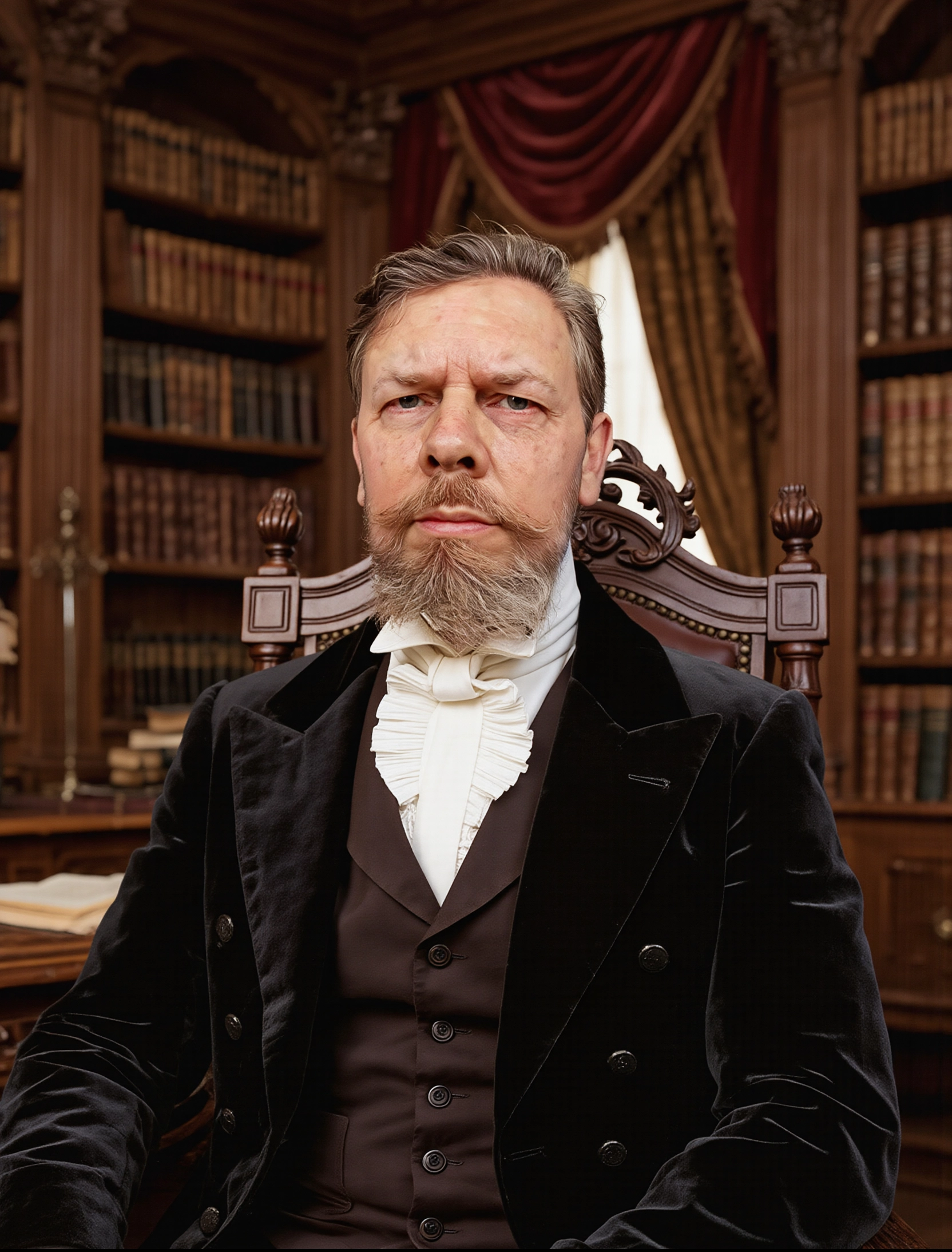
Author in period dress for the cover of his book on Isaac Singer.

Logline
The most famous industrial name of the nineteenth century belongs to a man almost no one remembers.
Extended Description · ~600 words
The most famous industrial name of the nineteenth century belongs to a man almost no one remembers. SINGER, in gold lettering on black cast iron, sat in tens of millions of households worldwide for well over a hundred years — in tsarist Russia and post-war Germany, in Brazilian sugar plantations and English country cottages. The machines came from Singer works on both sides of the Atlantic, among them the plant outside Glasgow that would grow into the largest sewing machine factory in the world. The brand outlived its founder by a century and a half. The man who built it died in 1875 and has been almost invisible ever since.
Isaac Merritt Singer — born in 1811 in upstate New York, the son of an indifferent immigrant millwright and a mother who walked out when he was ten — ran away from home at twelve. He spent the next twenty-eight years failing: as a touring stage actor, as a self-taught mechanic, as the inventor of a wood-and-metal carving machine nobody bought, as a married man who quietly began a second family at twenty-five and was, by 1860, keeping four households at once, three of them within a few miles of each other on Manhattan.
Then, in September 1850, in the corner of Orson Phelps's Boston workshop, with forty dollars and eleven days, he rebuilt the failed mechanism of the Lerow & Blodgett machine into the first machine that actually sewed — every part of it made by hand. Patent No. 8,294, granted on August 12, 1851, launched what would become the most successful manufacturing company of the century.
That story — the eleven days, the patent, the empire — is the part anyone who has heard of Singer thinks they know. The rest of his life is what this book is about: the patent war with Elias Howe that ended in America's first four-company patent pool; the lawyer named Edward Clark who, while Singer chased dimes, quietly invented mass installment credit, the branded showroom, and the global distribution network; the August afternoon on Fifth Avenue in 1860 when one of Singer's women saw him in his own yellow carriage with another woman beside him and screamed loud enough that Frank Leslie's Illustrated Newspaper carried the news in a hundred and fifty thousand copies, read by half a million people; the scandal that drove him to England; the young Parisian he married in New York in 1863, whose daughter Winnaretta would become Princesse de Polignac and use his money to commission Stravinsky and Satie — and keep Ravel in her salon; and the will he signed nine days before his death, which left his eldest son — the boy who had defended his abandoned mother in court — exactly five hundred dollars out of a fortune between thirteen and fifteen million.
The challenge of writing Singer is that he himself wrote almost nothing. Nearly illiterate, he wrote scarcely any letters, kept no diary, dictated no memoir. The only previous serious biography of Singer — Ruth Brandon's Singer and the Sewing Machine: A Capitalist Romance (1977) — reconstructed his life from court records, patent files, and a then-recently-rescued company archive. Yury Boldyrev's biography is anchored in Brandon's research and extends it through a methodical effort to restore the texture of an era — the smells, the silences, the weight of the things people carried.
Where Brandon describes the world Singer built, this book attempts to see that world through the man's own restless and contradictory eyes. Singer was a scoundrel. He was also, by some measurements, a builder of more freedom for ordinary women than any reformer of his century: every machine he sold collapsed fourteen hours of hand-sewing into one. Women didn't work less; they earned more. The contradiction is the book.
Written in the tradition of Ron Chernow and Erik Larson, the book combines documentary precision with cinematic immediacy. It is published on August 12, 2026 — the 175th anniversary of the patent that started it all.
Full Description · ~250 words
In August 1851, a thirty-nine-year-old failed stage actor named Isaac Merritt Singer received Patent No. 8,294 for an improvement to the sewing machine. By the time he died twenty-four years later, his name was the most famous in nearly every American home — and his estate, valued at between thirteen and fifteen million dollars, supported four families he had been keeping simultaneously, three of them within a few miles of each other.
Yury Boldyrev's Singer: The Scoundrel Who Changed the World is the first full-length narrative biography of one of the nineteenth century's least understood industrialists. Singer was nearly illiterate: he wrote scarcely any letters, kept no diary, dictated no memoir. The man behind the most recognized industrial brand of the long nineteenth century has, until now, been almost invisible.
Reconstructed from court records, patent files, contemporary newspapers, and the rare voices of his contemporaries — anchored in Ruth Brandon's foundational 1977 study, the only previous serious biography of Singer — the book follows him from a rainy night in Oswego, when he ran away from his father at twelve, to his death in Devon in 1875, in a temporary house beside the unfinished palace he had commissioned for himself. Along the way: the eleven days in a Boston workshop that produced Patent No. 8,294; the patent war with Elias Howe that ended in America's first four-company patent pool; the August afternoon on Fifth Avenue when his common-law wife saw him in his own yellow carriage with another woman, went to the police, and put the name Singer in print under the word "arrested" for the first time; and the lawyer Edward Clark, who, while Singer chased dimes, invented installment credit, the branded showroom, and the global distribution network — decades before there were words for any of those things.
Out now — published August 12, 2026, the 175th anniversary of Patent No. 8,294.
Short Description · ~80 words
Isaac Singer was nearly illiterate: he wrote scarcely any letters, kept no diary, dictated no memoir. By thirty-three he had failed as a touring actor; by thirty-eight, as an inventor. By the end of his life he owned a thirteen-to-fifteen-million-dollar empire. In eleven days in Orson Phelps's Boston workshop he turned someone else's failed mechanism into the first sewing machine that actually sewed. Patent No. 8,294 launched the most famous brand of the nineteenth century. Behind it stood a quiet lawyer named Edward Clark, who invented mass installment credit, branded showrooms, and the global distribution network — decades before there were words for any of it.

BOOK VITALS
Title: SINGER: The Scoundrel Who Changed the World
Author: Yury Boldyrev · Publisher: Yury Boldyrev
Published: August 12, 2026 · Kindle edition, 412 pages
Price: $9.99 · ASIN: B0HCLZT3ZQ
Territories: worldwide, English
Read it on Amazon → https://www.amazon.com/dp/B0HCLZT3ZQ
Author Q&A
Twelve questions and answers, ready for republication. Journalists may quote in full or in part — attributed to Yury Boldyrev. Each answer is 100–200 words and self-contained.
- Why Singer? Of all the figures of the nineteenth century, what made you spend two years on this one?
When I first read about Singer’s childhood — the absent father, the work begun too early, the education received in the field rather than in a classroom — I recognized the structure. Not the morality, not the choices, but the structure. A boy who has to work out the world by himself, with his hands, while his peers are still in school, ends up with a particular relationship to the world. Singer had it. I have it. That recognition didn’t make me sympathetic to his choices. It made me able to follow the logic of them, scene by scene, without flinching.
But the recognition came later. The seed came earlier — from a sewing machine in my grandmother’s apartment, black cast iron with the word SINGER in gold lettering. My great-grandmother received it in tsarist Russia in the early twentieth century. It stayed in the family for almost a hundred years and went through three generations. My grandmother said it had carried the family through two world wars, and she meant it literally — there were times when the presence of that machine and the ability to sew decided whether the family ate that day. We called it Zina, like a member of the family.
When I first asked who Singer was, no one could tell me anything beyond “the inventor.” Everyone knew the brand. Almost nobody knew it was the name of a man. That question — why the name remains when the man has vanished — became the seed of the book.
- What surprised you most in your research?
What surprised me most was a combination of two things in one man. Singer didn’t just survive — he searched, relentlessly, for a way to replace hand labor with a machine, while possessing none of the conditions usually required for such work. No formal education, no laboratory, no patron, no capital. He invented his way through poverty by sheer attention to the problem.
And he did all of this while running parallel families a short ride from one another. The same mind that could take apart the failed mechanism of an earlier maker and rebuild it, by hand, into the first working sewing machine was, simultaneously, sustaining four households at once, three of them within a few miles of each other on Manhattan, each one unaware of the others, for years.
Technical obsession and personal duplicity at that scale, in one man, was the surprise.
- How would you describe your relationship to your subject?
Honest, not affectionate. Singer was a scoundrel. By her sworn testimony, he beat his common-law wife unconscious in front of their children. He left his eldest son five hundred dollars out of thirteen million, for the crime of taking his mother's side in court. He fathered twenty-four children by five women and treated most of them as evidence of his existence rather than as people.
He was also — by some measurements — a builder of more freedom for ordinary women than any reformer of his century. Every machine he sold collapsed fourteen hours of hand-sewing into one. Women didn’t work less; they earned more. The contradiction is the book.
My job is not to defend him and not to condemn him. My job is to tell the story precisely. The conclusions I leave to the reader.
- Singer was almost illiterate and left almost nothing in his own hand. How do you reconstruct a man who barely wrote?
Through everyone around him. Singer himself wrote almost nothing — but his lawyer wrote, his partners wrote, his wives sued him, his employees gave depositions, his patent files survive, and the New York newspapers covered him relentlessly. By 1860 Frank Leslie's Illustrated Newspaper was reporting on his domestic violence in a hundred and fifty thousand copies, read by half a million people.
The only previous serious biography of Singer is Ruth Brandon's Singer and the Sewing Machine, published in 1977. Brandon had access to the company archive, and her work is the foundation everyone who came after has stood on. My book is anchored in her foundation and extends it through a methodical effort to restore what the documents don't carry — the smells, the silences, the weight of the things people carried.
And to be honest: a few of the smaller textures came from lived familiarity rather than archives. The feel of work begun too early, of learning by doing rather than by reading — that part was already familiar. Most of the book is documentary reconstruction. A handful of the smaller gestures are remembered.
- How is your book different from Brandon’s?
Brandon wrote an academic capitalist romance — patient, thorough, written from outside. Her access to the lost Singer archive in 1977 made her the foundation for everyone who came after. I am working from her shoulders, not in her place.
The difference is point of view. Brandon shows the world Singer built. I try to see that world through his restless and contradictory eyes — the rainy night in Oswego, the eleven days in the Boston shop, the carriage on Fifth Avenue, the will at the end. Written in the tradition of Ron Chernow and Erik Larson, the book combines documentary precision with cinematic immediacy.
The other difference is what we now know that Brandon could not have known in 1977 — about Edward Clark, about the long-term shape of consumer capitalism, about how strangely modern Singer’s biography looks from a 2026 vantage point.
- Why does Edward Clark matter?
Because he built the things we still live inside. Singer made the machine; Clark made the company that put the machine in every home. While Singer chased dimes and women, Clark invented mass installment credit — buy now, pay five dollars a month — which became Apple Card, Klarna, every car loan, every "Buy Now Pay Later" button. He built the branded showroom, a store designed not as a warehouse but as an experience, which became the Apple Store. He created the trade-in program. He assembled one of the first true global distribution networks — from Glasgow to São Paulo to Manchester — decades before Amazon.
Clark didn’t put his name on any of it. He stayed deliberately, almost pathologically quiet. By the standards of nineteenth-century capitalism he was the architect; by the standards of fame he was invisible. He was also — in his own way — morally compromised: he stayed and worked alongside Singer for two decades and knew exactly what kind of man he was working with. The book is, among other things, a study of what it costs to build the modern world from the shadows.
- You call him a scoundrel in the title. Is that the verdict?
It’s the title. The verdict is the reader’s.
The word scoundrel does specific work. It’s honest about the man without flattening him into a villain. Singer was charming when he wanted something — mechanical help, business help, a woman in his bed. Once he had what he wanted, he stayed reasonably loyal — he didn't drop his women, he kept up family life with each of them, he kept his children fed and housed while he lived. He simply did not do morality in any sphere. He took what he wanted, when he wanted it, and made the rest of the world pay for the consequences. That’s a scoundrel — not a villain, not a saint, not a misunderstood genius.
What’s strange about him from a 2026 vantage point is how familiar he looks. Charming when he wants something, indifferent to morality, brilliant at the thing he built. Singer was, in many ways, a nineteenth-century version of a particular twenty-first-century type.
- What had to be cut from the book?
Three volumes' worth of material, easily. Singer's life was so dense with incident that the challenge was selection, not invention.
Even the childhood: he ran away with traveling theater troupes more than once, came back to his brother's shop, ran again, eventually worked his way to a professional acting career under his middle name, Merritt. Each of those returns is a chapter that didn't make the book.
One famous anecdote I chose not to take at face value. Edwin Dean liked to recall how young Singer walked up to him in Rochester, recited Richard's lines on request, and was hired for the title role on the spot — a story told decades later by a man who by then owed Singer his St. Louis agency. In the book, Isaac hides in a scenery wagon and earns the stage slowly: crowd parts first, then three words, then a king. I made a similar choice with his mechanic's training. The 1853 interview claims he mastered the trade in four months; even Brandon, his most careful biographer, remarks that nobody learns a trade in four months, however gifted. The book gives him years at the bench, because the precision his hands showed for the rest of his life was not acquired in a season. Where the only source is a legend told by an interested man, I reconstruct the more plausible version — and say so openly. That is not fiction replacing fact; it is choosing between two unverifiable stories, with the reader informed.
My criterion was simple: every scene in the book had to be both emotionally and historically necessary, and had to rest on documentary evidence. Some moments are decorated with invented secondary characters — a workman in the shop, a bystander on the street — to give a scene the texture it needed. But every central event, every named figure, every dated incident is on the record. The fictional element serves the documentary spine, not the other way around. What got cut was usually material that was true but not necessary — a third theatrical triumph, a fourth failed invention. There will, eventually, be other Singer books for that.
- Who is this book for?
Two readers in particular.
The first is the reader of narrative non-fiction in the tradition of Ron Chernow, Erik Larson, and Walter Isaacson — someone who reads biography for the texture of a life rather than for a moral conclusion, who wants the historical specificity and the cinematic immediacy together. Readers of Titan or The Devil in the White City will find this form familiar.
The second is the reader interested in the history of capitalism. Singer is one of the cleanest case studies of how the modern consumer economy actually came into being — not as a theory, not as a policy, but as a series of practical decisions made by two men in a Manhattan office between 1851 and 1875. Anyone trying to understand why the world we live in is shaped the way it is will find a great deal of it traceable to that office — and to the man who didn’t know what he was building.
- How did your background in screenwriting shape the book?
My path to the page came through my hands. I worked with materials before I worked with words — construction sites and vineyards as a child, then two decades painting cars and running body shops — and the discipline of building things turned out to be the foundation of everything else. The move to screenwriting and to the page came late but logically. Working in screenwriting changed how I see scenes — and a biography, in the end, is a series of scenes.
The film discipline teaches you to cut anything that doesn’t earn its place: every scene must move the character or the action forward, the period must arrive through specific objects rather than general description, and the camera must always know where it is.
The rhythms are different in prose, but the principles transferred directly. The book is structured as a sequence of scenes anchored to specific dates and locations, each one chosen for both its emotional and its historical weight. The camera — to use the screenwriting word — stays with the people in the room. The result, I hope, is that the reader does not feel they are reading about the nineteenth century from outside, but standing inside it, in a particular shop, on a particular street, in a particular hour of a particular day in 1851 or 1860 or 1875.
- Why is the book being released on August 12, 2026?
August 12, 2026, is the 175th anniversary of U.S. Patent No. 8,294 — the patent that started everything. Granted to Isaac Singer on August 12, 1851, it is the document on which the entire subsequent empire rests. Without it, there is no Singer Manufacturing Company, no Edward Clark, no installment plan, no global distribution network, no SINGER on the cast iron of millions of machines. Tying the publication to that date is not a marketing trick — it’s a historical anchor. Books about historical figures benefit from coinciding with public memory, and a 175-year anniversary is real public memory: museums mount exhibits, archives release files, journalists look for stories. The book is built to meet that moment.
- What’s next? Is there a Singer cycle?
There is. The Singer book is the first in a cycle of narrative biographies and untold histories of the long nineteenth century — figures the canonical history has overlooked, simplified, or actively erased.
In parallel with the books, I am developing a multi-season dramatic series adaptation. The series bible and the pilot script for the first season are written and available to qualified partners on request. An animated film about Singer's childhood, the runaway years, is also in development.

Boilerplate
For the end of press releases, newsletter footers, and partner communications. Use as-is.
Short
Singer: The Scoundrel Who Changed the World, by Yury Boldyrev, is the first full-length narrative biography of inventor and entrepreneur Isaac Merritt Singer. It is published on August 12, 2026 — the 175th anniversary of U.S. Patent No. 8,294. More at singerseries.com.
Long
Yury Boldyrev is a writer and screenwriter based in Varna, Bulgaria. His first book, Singer: The Scoundrel Who Changed the World, is the first full-length narrative biography of Isaac Singer, published on August 12, 2026, the 175th anniversary of U.S. Patent No. 8,294. The book is the first in a planned cycle of narrative biographies and untold histories of the long nineteenth century. A multi-season dramatic series adaptation is in development.
Press: press@singerseries.com
Yury Boldyrev answers press mail personally, usually within a day. Inquiries in English, Russian and Bulgarian welcome.
Partnerships: info@singerseries.com
singerseries.com

WHY NOW
On August 12, 2026, U.S. Patent No. 8,294 turned one hundred and seventy-five years old. It is the patent that put a sewing machine into tens of millions of homes and made SINGER the most recognized industrial name of the nineteenth century. The man whose name is on it had never had a full biography. This one published on the anniversary itself.
Pull Quotes from the Author
For interview placement, social cards, and article highlights. Attributed to Yury Boldyrev.
“Brandon’s book shows the world Singer created. Mine attempts to see that world through his eyes. I don’t presume to judge his choices. I tell the story; I leave the conclusions to the reader.”
“Greed as the engine of civilization.”
“America’s first tech bro — decades before Silicon Valley.”
“Singer and Clark were two blades of a pair of scissors — useless apart, equally sharp.”
“I had to work things out with my hands before I worked them out on the page. So did Singer.”
“The most famous industrial name of the nineteenth century belongs to a man almost no one remembers.”
“Singer was a scoundrel. He was also, by some measurements, a builder of more freedom for ordinary women than any reformer of his century. The contradiction is the book.”
“Singer made the machine. Edward Clark made the company that put the machine in every home. While Singer chased dimes, Clark invented installment credit, the branded showroom, and the global distribution network — decades before there were words for any of those things.”
“Singer didn't scatter his families across the country. He kept three of them within a few miles of each other on Manhattan. The women could have passed on the street.”
“He left his eldest son five hundred dollars out of thirteen million. The arithmetic is the verdict.”

Email: Info@SingerSeries.com Copyright © 2026 Singer Series