
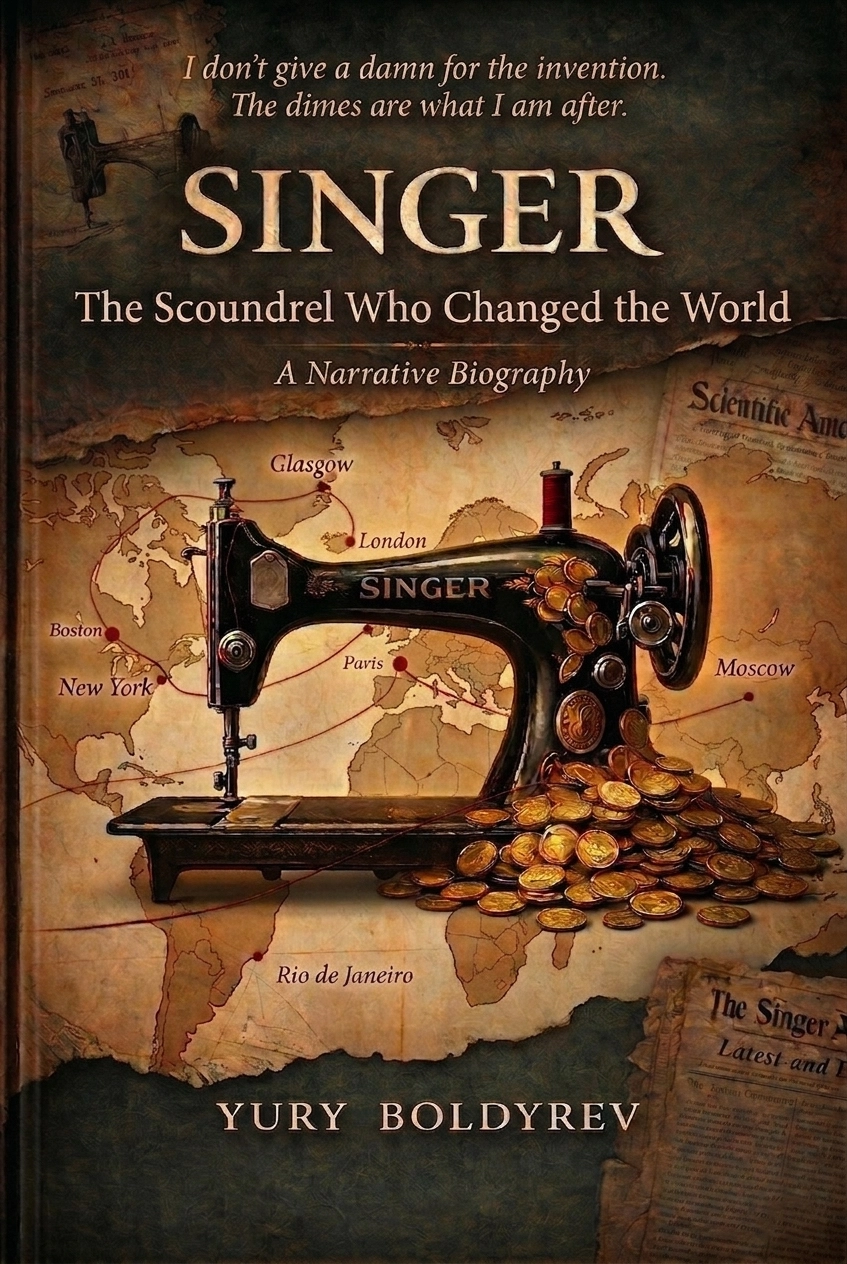
SINGER
The Scoundrel Who Changed the World
He didn't invent the sewing machine. He invented modern capitalism.
A century and a half before the iPhone, a runaway actor named Isaac Singer and a cold-blooded lawyer named Edward Clark built the financial and marketing systems that still run your life today.
Instant PDF · No spam · Unsubscribe with one click
A pathological hunger that, by sheer accident, freed millions of women from the needle.
This is not another tale of boundless success.
Isaac Singer had no conscience, and he came to letters late — he learned to read at a free evening school for workmen, out of a primer, at an age when other boys had long finished. He had only the instinct of a predator and an unquenchable thirst for recognition.
Edward Clark was his brain — the legal shark who turned chaos into cash.
Together, they forged the matrix of modern consumer capitalism. Installment payments. Flagship retail. Aggressive trade-ins. Global branding. Patent warfare. Every tactic a Silicon Valley founder uses today, these two men weaponized first — in the 1850s.
The machine survived. The legend survived. The man almost disappeared.
Until now.
Inside the book
An empire built in eleven days
Singer didn't invent the sewing machine. He harvested broken ideas from failed inventors and reassembled them into a working machine in less than two weeks. You'll see exactly how — and why the same "remix" mindset still mints billionaires today.
The methods that still rule your wallet
The installment plan that put a hundred-and-twenty-five-dollar machine into a five-hundred-dollar household: five dollars a month, and it's yours. The trade-in carried to its cruellest — competitors' machines broken up with sledgehammers, in front of the customer, until nothing is left but shards. Flagship showrooms on Broadway — the true ancestors of the Apple Store, a century and a half early.
The price of grandeur
Four parallel families within a few miles of one another. Twenty-four children. A public bigamy scandal that forced him to flee across the Atlantic under a false name. A thirteen-to-fifteen-million-dollar fortune that triggered the legal battle of the century. This is not a sanitized biography — it's a forensic investigation into the moral cost of ambition.
24 Chapters. One Unforgettable Life.
ACT I — HUNGER
1811—1850
the making of a predator
Chapter 1. The Escape 1823
Oswego, New York State, an autumn evening. The father calls twelve-year-old Isaac a burden at a table where his place is not set. That same night, in the rain, the boy walks out — almost seventy miles ahead of him to Rochester, where his older brother keeps a mechanical workshop. This is Singer's first escape. For the next forty years he will run from anyone who dares to see him weak.
Chapter 2. His Brother's Shop 1823—1829
Rochester, a boom town on the Erie Canal. In his brother John's shop the boy learns to swing a hammer, fire a forge and read a drawing; from the German master at the next bench he learns to love iron. One autumn evening in 1828, on the square in front of the church, a traveling troupe plays Richard III. Edwin Dean, as the hunchbacked king, says: "I am determined to prove a villain" — and Isaac forgets to breathe. A second hunger is born, and it will prove stronger than the first.
Chapter 3. The Stage as a Drug 1829—1836
At eighteen he leaves the trade for a traveling company and a stage name: Isaac Merritt. He plays Richard III and holds himself the best Richard of his time; the critics call the talent middling. Fifteen-year-old Catharine Maria Haley sees him from the house and falls in love on the spot. December 1830, Palmyra, New York: a quiet wedding in her parents' front room, with no one there from the groom's side. Four years later their first son is born and given the name Isaac had wanted — William. Catharine will wait for him in rented rooms, year after year, while he is away on tour.
Chapter 4. The Double Life Begins 1836—1838
Baltimore, spring 1836. On tour, the twenty-four-year-old Singer picks an eighteen-year-old out of the audience: Mary Ann Sponsler, a tradesman's daughter. He introduces himself as Isaac Merritt and says nothing of Catharine or the child. He proposes; he promises marriage. When Mary Ann follows him to New York and finds the first wife and the son, she stays. For the next twenty-four years it will run this way — "Mrs. Merritt" in public, "Mrs. Singer" at home.
Chapter 5. Canal—The Bottom 1838—1839
Lockport, Illinois. Singer digs the Illinois canal for a dollar a day beside men dying of fever. On May 16, 1839, he is granted the first patent of his life — No. 1,151, a machine for drilling rock — and sells it for two thousand dollars. The ditch-digger becomes an inventor. Here the formula sets that he will build everything on: the trade is the road up, the stage is the shortcut to fame.
Chapter 6. The Theater and the Machine 1839—1844
On the two thousand dollars from his patent Singer founds a traveling company in Chicago — the Merritt Players. Five years of touring Ohio and Indiana; Mary Ann bears four children in hotel rooms as "Mrs. Merritt." Then the company begins to come apart: one actor steals two dollars from the till and vanishes into the waterfront slums of Cincinnati. In the autumn of 1844 the theater of Isaac Merritt ends in a barn by an Ohio road — half a dollar to the farmer for the night, the children asleep in the hay, Mary Ann beside them. Only the machine had ever brought money.
Chapter 7. The Inventor Whose Things Always Explode 1844—1850
Odd jobs in the print shops of Pittsburgh. Singer notices that signboard letters are cut by hand, hours to a word, and designs a machine for carving wood and metal; on April 10, 1849, he receives his second patent, No. 6,310. George Zieber, a Philadelphia publisher, stakes seventeen hundred dollars on an industrial prototype. February 4, 1850, in the New York shop of A. B. Taylor & Company, the steam boiler bursts. The prototype is gone. Sixty-seven people are dead. Singer earns the name that will follow him for years: the inventor whose things always explode.
ACT II — EMPIRE
1850—1860
the seizure of power
Chapter 8. A Meeting with Fate June—September 1850
Zieber talks Singer into Boston, into Orson Phelps's workshop at 19 Harvard Place, to sell the carving-machine patent there. There are no buyers. What the shop actually does is repair the bad-tempered Lerow & Blodgett sewing machines, whose needle swings in an arc and whose cloth jams. When Phelps mentions what a working machine might earn, Singer says the line that will define the rest of his life: "I don't give a damn for the invention. The dimes are what I am after."
Chapter 9. Eleven Days of Genius September 1850
Singer moves into the workshop. Three hours of sleep a night, one meal a day. Forty dollars for materials — everything there is. On the eleventh night the machine drops a stitch and Phelps, worn out, has gone home. Singer changes the tension of the upper thread. The machine sews five perfect stitches in a row. Then he weeps. Three seconds. Then back to the figures.
Chapter 10. The Patent and the First Betrayal 1850—1851
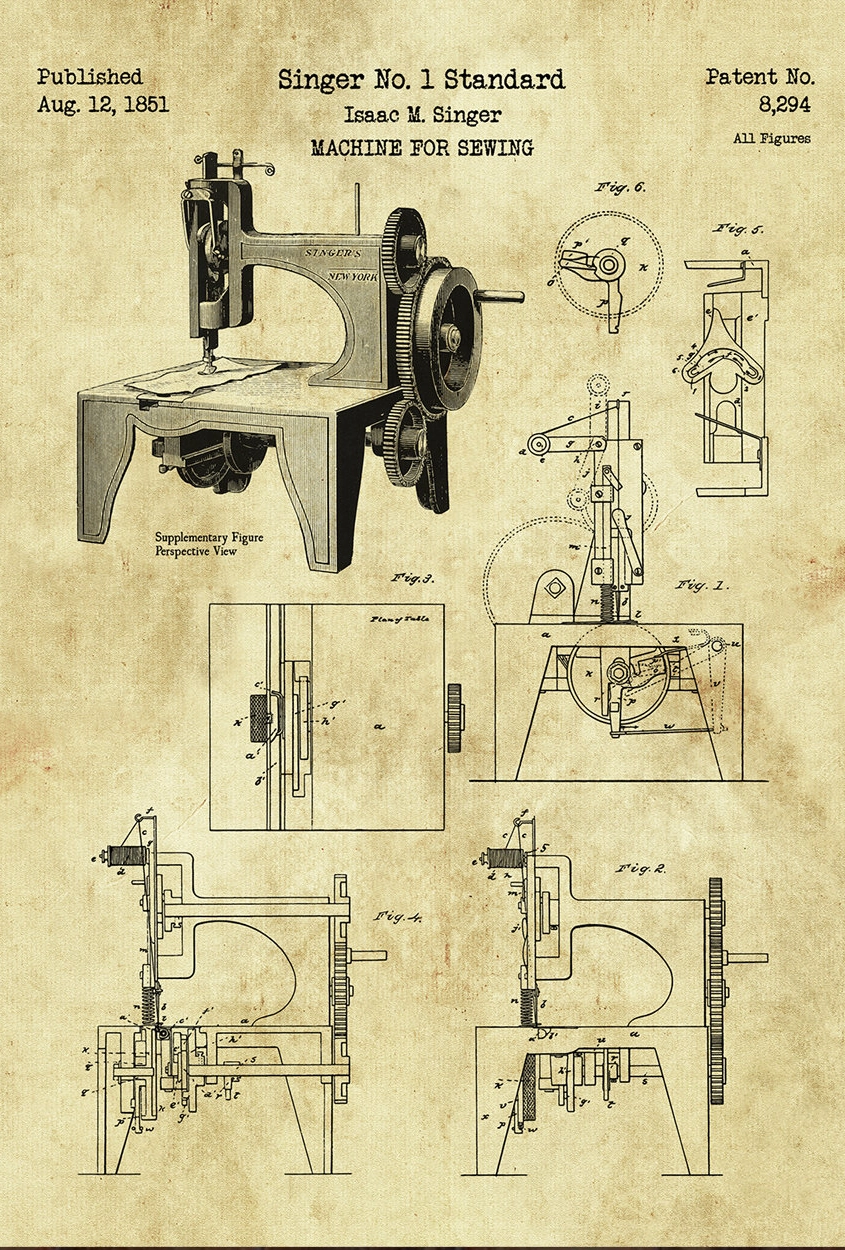
Three partners on a handshake — Singer, Phelps, Zieber, equal shares — and a machine that carries a name out of the contract: the Jenny Lind, after the Swedish singer Barnum has just brought to America. Then the notice appears in print, and there is no Jenny Lind in it and no partners either. On the sheet Isaac sees one thing only: Singer. On August 12, 1851, United States Patent No. 8,294, "Improvement in Sewing-Machines," is granted in his name alone. He had only just assembled his team, and he had already begun to take it apart.
Chapter 11. An Alliance of Opposites 1851—1852
Singer needs a lawyer for the patent fights. Ambrose Jordan will not represent him — the man is personally intolerable — and sends him one floor down, to his junior partner and son-in-law: Edward Clark, Williams College, a former Sunday-school teacher, cold as glass. December 1851: Zieber goes down with a fever. Clark draws up the papers; a fortnight later Singer appears at the bedside. The doctor thinks you won't get over this, he says. Don't you want to give up your interest? Six thousand dollars, and Zieber signs in bed. When he recovers and understands what has been done to him, he will write: "If I had been suddenly condemned to be shot, I could not have been more stunned."
Chapter 12. The Patent War 1853—1856
Elias Howe holds the founding patent on the lockstitch, and in 1853 he mortgages his father's farm to pay his lawyers. Clark tells Singer to play the self-taught man of the people in court; the mask does not hold. In 1854 the case is lost — fifteen thousand in damages and twenty-five dollars in royalty on every machine sold. Then, on October 24, 1856, in Albany, the four largest firms — Singer, Howe, Wheeler & Wilson, Grover & Baker — pool nine patents into the Sewing Machine Combination. The first patent pool in American history; the same device will later clear the way for radio, cinema and the automobile.
Chapter 13. Inventing America 1856—1858
The machine costs a hundred and twenty-five dollars; a whole year brings the average family five hundred. Clark finds the opening — call it not credit but hire, five dollars a month, and the machine is yours. One of the first consumer-credit schemes in America. Beside it he sets the trade-in, with competitors' machines broken up in public, before a cheering crowd — a move Apple will make again a century and a half later.
Chapter 14. The Showman on Broadway 1857—1858
The showroom opens at 458 Broadway: gilt cornices, a marble floor, women demonstrating machines in the window. Buying as an experience rather than a transaction, a century and a half before the Apple Store. Singer stages it in the Barnum manner — five seamstresses against one machine, nine hundred stitches a minute against forty — and from the platform he reads Thomas Hood's "The Song of the Shirt." In the window his own young son sews all day, and his father does not pay him for the work.
Chapter 15. The Global Empire 1859—1860
Gears instead of a straight drive; quieter than Wheeler & Wilson, lighter than Grover & Baker — seventeen improvements in a single model, and his last surge as an inventor. On June 8, 1859, Walter Hunt dies in New York: the man who had built a sewing machine before Howe and never patented it. At the board table Singer and Clark fight openly over the presidency for the first time — if not me, then not you either — and the board hands it to a third man. On the factory floor, among the women workers, Mary McGonigal is no longer an accident: she already has children living under another of Singer's surnames, Matthews.
Chapter 16. The Yellow Carriage 1860
The family omnibus he had patented in October 1859 comes out onto Fifth Avenue: canary yellow, thirty-one seats, nine horses in the team, beds for the children, a lavatory built in, an orchestra on the roof. Sixteen thousand dollars — twenty years of a factory hand's wages. New York society takes the carriage as an insult, and the insult is the point: he means to be seen.
Chapter 17. Four Families 1860
On January 23, 1860, Singer formally divorces Catharine, naming her adultery with one Stephen Kent. By that day he keeps four parallel families inside a single New York: Catharine with two children; Mary Ann Sponsler with ten on Fifth Avenue; Mary McGonigal with five under the surname Matthews; Mary Eastwood Walters with a daughter, Alice. Clark sees the true scale of the lie for the first time — and one evening, when Singer starts on yet another demonstrator, says coldly: do something about it, or I will.
ACT III — EXILE
1860—1905
the final curtain
Chapter 18. Disaster on Fifth Avenue August—September 1860
August 7, 1860, a sunny noon on Fifth Avenue. Mary Ann Sponsler is out in her own carriage when she sees Isaac Singer coming toward her in an open phaeton with Mary McGonigal beside him. She orders the driver to stop, gets down and screams the length of the avenue: "Scoundrel! That's my husband!" That same evening, at home, Singer beats Mary Ann and their daughter Voulettie; Mary Ann loses consciousness. Frank Leslie's Illustrated Newspaper, a hundred and fifty thousand copies a week, prints a notice of the arrest of "the great sewing-machine manufacturer of No. 14 Fifth Avenue." Within six weeks his own partners put him out of the country. "On that day I felt myself dead," Mary Ann will say later.
Chapter 19. The Exile September 1860—November 1862
New York — London — Paris. After the scandal on Fifth Avenue, Mary Ann drags Singer through the New York courts: assault, maintenance, a charge of bigamy. Each round the same — arrest, bail, another crossing of the Atlantic. He travels as J. W. Simmons, and by the end of 1862 he has left American public life for good and taken it up again on the other side of the ocean.
Chapter 20. Isabella November 1862—October 1863
Paris, November 1862, the tenth arrondissement, rue de Lancry. Isabella Eugénie Boyer — twenty-one years old, the daughter of a ruined Paris confectioner. This time Singer has millions, and the confectioner gives way. They cross the Atlantic, and on June 13, 1863, Isaac marries Isabella in New York, at the Church of St. John the Evangelist on Waverley Place: the bride is thirty years his junior and six weeks from giving birth. She is his last woman. And, for the first time in his life, the only one.
Chapter 21. The Empty Ball 1864—1866
Above the Hudson at Yonkers, Singer raises The Castle out of gray granite and throws a reception for New York society. Hundreds of invitations, tables the length of the hall, an orchestra brought up from the city. Almost nobody comes. Society sends footmen with its regrets; his older children do not come either. He and Isabella sit alone in a hall laid for hundreds while the waiters carry the cooling dishes past the empty chairs. Within two years he takes the family away for good. He was not driven out of America — he was simply never let in.
Chapter 22. The Wigwam 1867—1874
Paignton, Devon, in the south of England. The Wigwam — the enormous house Singer commissions in 1873 from a local architect, George Bridgman: a private theater on the ground floor, a rotunda that is a riding-school by day and a ballroom by night. He never lived to see it finished. In October 1873, on his sixty-second birthday, his children by Isabella play on a stage put up in the hall of Little Oldway, the temporary house next door — the dream of the boy from the Rochester workshop, finally staged. In the town he buys circus tickets for every child and pays for a feast for eight hundred Paignton schoolchildren. His own children he barely sees. "My children hate me," he tells Isabella. "But these will remember." (His son Paris would later rebuild the estate into the 115-room Oldway Mansion.)
Chapter 23. Death and Legacy 1875—1876
The will was drawn in Paris on July 16, 1870 — not a deathbed gesture but a cold calculation made five years early. To William, his eldest, who had dared take his mother's side in court: five hundred dollars out of an estate of between thirteen and fifteen million. To Lillian, who stood by her brother: ten thousand. To Mary Ann Sponsler, twenty-five years of his life: nothing at all. To Isabella — the estate, the horses, the carriages, the silver, all of it. Then Devon, July 1875: a chill in May, a worn-out heart, and on the twenty-third he dies at Little Oldway at sixty-three. Three coffins, one inside the other — cedar, lead, oak with silver. Two thousand people walk behind the hearse to Torquay in pouring rain. Above the grave, for the first time in his life, falls a real and undisturbed silence. That year the company he leaves behind sells a quarter of a million machines — and the whole empire passes to his fifth wife and to children he hardly knew.
Chapter 24. Thirty Years Later Paris, 1905
Avenue Henri-Martin, the music salon. Winnaretta Singer — Princesse Edmond de Polignac these twelve years — closes the quarterly report of The Singer Manufacturing Company. Two million machines a year. Nine of every ten sewing machines sold on earth are theirs. The Clydebank works in Scotland, opened twenty years ago, is the largest industrial site on the planet; the new Podolsk works in the Russian empire, three years old, are already running. Her mother Isabella died in this house last spring. The will took two afternoons to read. The world has moved a long way in thirty years: Edison's lamps burn from Vienna to Buenos Aires, Marconi's signals cross the Atlantic in seconds, two American brothers have lifted a heavier-than-air machine off a North Carolina dune, and a clerk in the Bern patent office has just rewritten the relation of mass to energy. Last Tuesday Maurice Ravel played his pavane on the Pleyel here, with Gabriel Fauré, newly appointed director of the Conservatoire, in the front row. She has heard of a young Russian, a pupil of Rimsky-Korsakov — Stravinsky, twenty-three this year, not yet in Paris. He will come, and his Renard will be hers. Across the Channel, in a Torquay churchyard, a marble slab has been weathering for thirty summers: ISAAC MERRITT SINGER · 1811—1875. From below, through the open door of a dressmaker's shop, comes the familiar sound. Ta-ta-ta-ta. The greed of one man bought, out of history, thirteen free hours a day for every woman he despised in life. The world now runs on the scoundrel's rules. That is his only monument.

What happens after Chapter Twenty-Four
Stay with the story
You’ve just seen the map of the book — twenty‑four chapters that follow a runaway boy from Oswego into the heart of modern capitalism. The finished biography is out now. If you'd rather taste it first, take Chapter One free — and the research that never fit between the covers comes with it: behind-the-scenes notes and deleted scenes from the Singer archive.
Or, if you’d rather wander:
– Read the essays about Clark, Howe, and the women around Singer →
– See the full Singer Series project and what comes after this book →
Instant PDF · No spam · Unsubscribe with one click
Begin with Chapter One, free. The whole book is out now on Kindle — paperback and audio to follow.
Email: Info@SingerSeries.com Copyright © 2026 Singer Series