
The Singer brand needed a face. Isaac Singer gave it one — six foot four, broad-shouldered, bearded, a former Shakespearean actor who could fill a hall and a scandal with equal ease. But every empire of any consequence has a second man, the one who never appears in the official portrait. The one who keeps the lights on while the founder is out signing autographs or escaping the law.
Behind the Singer brand stood a Manhattan lawyer named Edward Clark. He kept his suits dark and his sentences long. He taught Sunday school. He never once entered the public mind the way his partner did. And he did three things that made the modern consumer economy possible: he engineered the first patent pool in American industry, he invented the installment plan, and he ran the company while the founder hid in Europe.
By the time he died in 1882, his estate was estimated at twenty-five to fifty million dollars — about double Isaac Singer's. The building he commissioned the year before he died, on the corner of Seventy-second Street and Central Park West, became one of the most famous addresses in the world. Clark never saw the Dakota finished. But the system he built — credit, retail networks, brand discipline, patent diplomacy — is what most of us walked through this morning without noticing.
This is his story.
Key facts
- Edward Cabot Clark, born 19 December 1811, Athens, New York; died 1882.
- Williams College, 1831; lawyer; married Caroline Jordan, 1835.
- Joined I. M. Singer & Co. in 1851 as an equal third partner, in lieu of fees; when the patent issued that August, he and Singer split the rights fifty-fifty.
- Invented the installment plan; engineered the Sewing Machine Combination (first U.S. patent pool).
- Ran the company while Singer fled to Europe after the 1860 scandal.
- Commissioned the Dakota, Central Park West (completed 1884).
- Estate at death: twenty-five to fifty million dollars — about double Singer's.
From Athens to Williams College
Edward Cabot Clark was born on December 19, 1811, in Athens, Greene County, New York — a Hudson River town his grandfather had helped settle. His father, Nathan Clark, ran the Athens Pottery Works, one of the most successful potteries in the region. The family was Protestant, prosperous, and the kind that understood education as both inheritance and weapon.
After four years at Lenox Academy in Massachusetts, where he absorbed Latin and Greek, Clark entered Williams College in 1826. He graduated in 1831 with a tolerable academic record and the credential that mattered most in mid-nineteenth-century America: a network. From Williams he moved into the law office of Ambrose L. Jordan, one of the state's leading attorneys, who would later serve as Attorney General of New York. Three years later, he passed the bar. In 1835, he married Caroline Jordan — Ambrose's daughter — and joined his father-in-law's firm. Jordan & Clark, on Nassau Street in lower Manhattan, became one of the better-known patent practices in the city.
By the 1840s Clark had a steady reputation, a comfortable Manhattan address, and a methodical practice. None of it was unusual. None of it predicted what was about to happen.
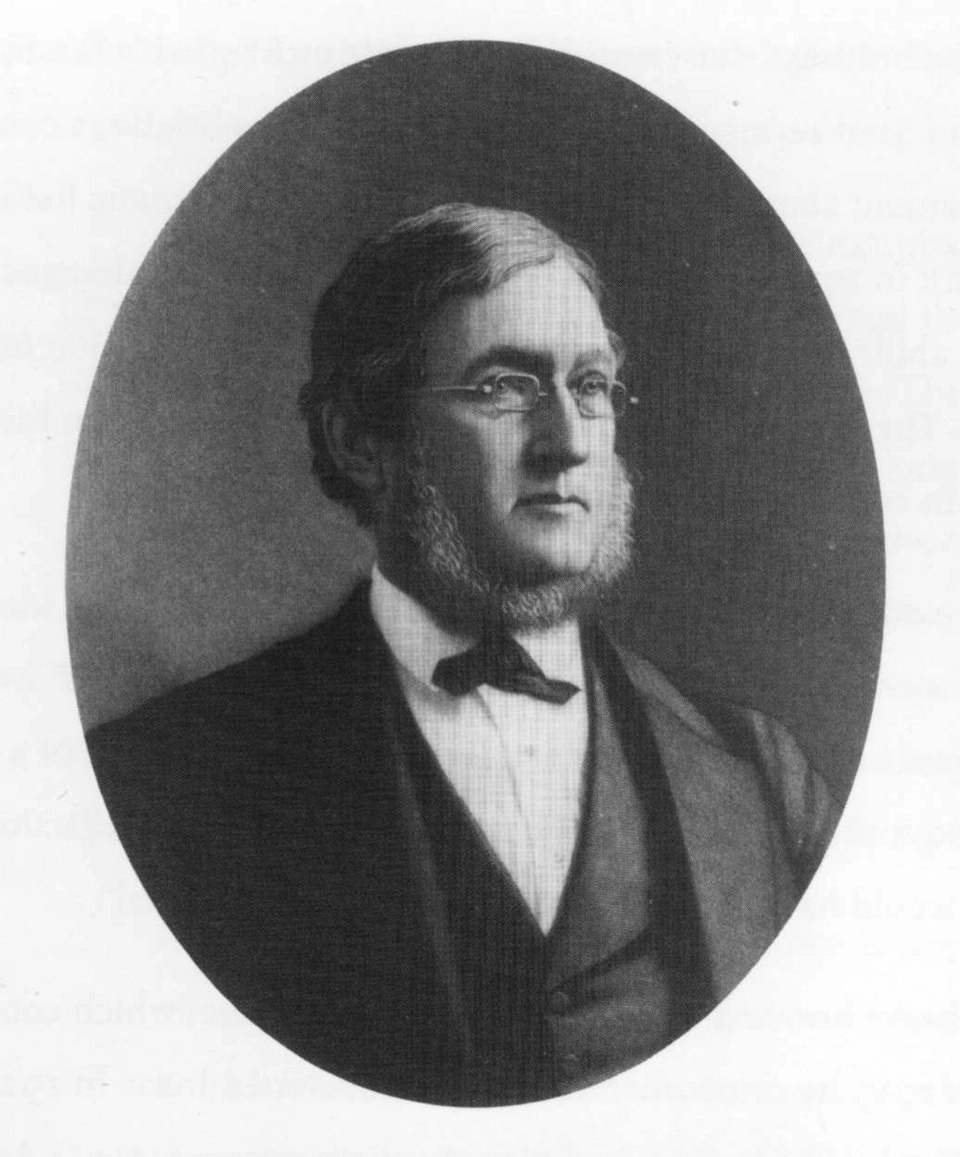
Edward Cabot Clark
The meeting with Singer
Isaac Merritt Singer walked into Jordan & Clark in 1851 with a patent he could not afford to defend. His improved sewing machine — not invented from scratch but assembled, the way nearly everything important in early-nineteenth-century American technology was assembled — was nearly ready for production. The original company was I. M. Singer & Co. in name only. Behind it stood George B. Zieber, a Philadelphia publisher who had financed Singer through years of failure and was the only man on earth who had backed him before there was anything to back. But Elias Howe, the holder of the foundational lockstitch patent, was preparing to demand twenty-five dollars in royalties on every machine sold. The number made the business unworkable.
Clark agreed to take the case. Singer had no money to pay him, so he offered a share of the business instead — an equal third, on the same footing as himself and Zieber, without a dollar changing hands. Clark accepted. It was not their first arrangement of this kind. In October 1850 Singer had already signed over three-eighths of the patent rights on his wood-carving machine, also in place of a fee, and Clark had made nothing from it.
This is the deal that made the entire Singer empire. Almost no one knows about it.
Patent No. 8294
On August 12, 1851, the U.S. Patent Office issued Patent No. 8294 to Isaac Merritt Singer. It made three claims: the motion of the shuttle and needle, the control of the thread, and the engagement of the bobbin. Only once the patent existed did the rights to it become legally assignable — and they were assigned equally between Singer and Clark. Zieber, still nominally the third partner, was handed a document promising him a third of the profits on condition that he gave the business his full attention. Profits, not ownership. The lawyer was no longer a lawyer at the table. He owned half of an industry that did not yet exist.
Within a few years Zieber was gone. Singer and Clark — Singer leading, Clark drafting the documents — pushed him out of the company through a combination of pressure, illness, and opaque accounting. Zieber would later write, in a line that has survived him better than the company stock he was robbed of: "If I had been suddenly condemned to be shot I could not have been more stunned." The man who had funded Singer when no one else would was the first casualty of the partnership that replaced him.
What followed was the deeper work — turning a mechanical curiosity into a global brand.
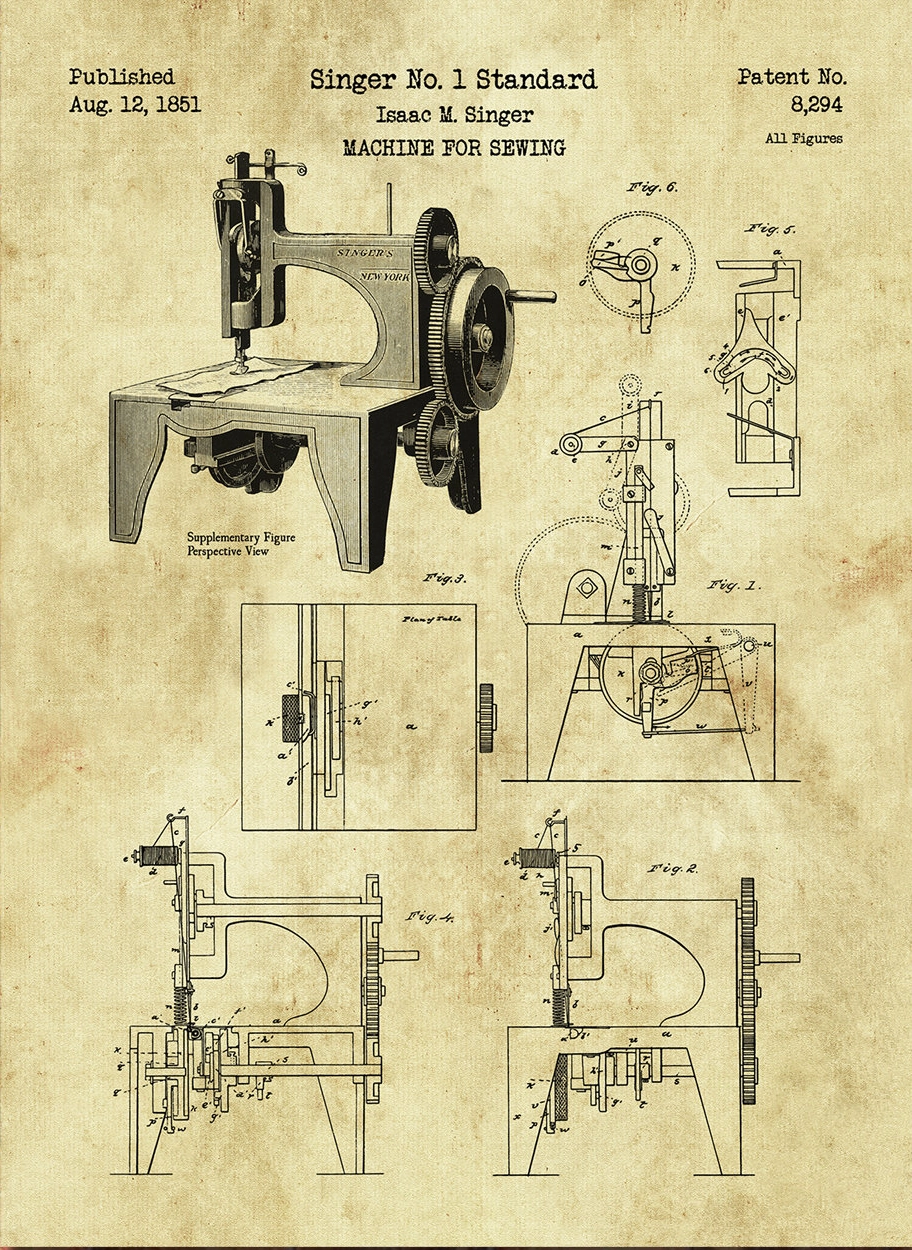
Patent No. 8294
The patent wars and the invention of the patent pool
By the mid-1850s, the American sewing machine industry had collapsed into legal warfare. Howe was suing nearly every manufacturer. Wheeler & Wilson was suing Howe. Grover & Baker was suing both. The companies were spending more on attorneys than on machines. In trade journals of the period, the years from 1853 to 1856 became known as the Sewing Machine Wars.
Clark wasn't an inventor. He was something rarer — someone who understood the architecture of intellectual property the way Singer understood the architecture of a needle. In October 1856, before another federal trial in Albany, Clark and a competing attorney named Orlando B. Potter proposed something that had never been done in American industry: pool the patents.
The Sewing Machine Combination
The four major manufacturers — I. M. Singer & Co., Wheeler & Wilson, Grover & Baker, and Howe himself — agreed to combine their nine essential patents into a single licensing trust. The Sewing Machine Combination, as it was called, charged a fixed royalty per machine to anyone in the United States who wanted to use the protected technology. Howe received a privileged five dollars on every machine sold domestically and one dollar on every machine exported. Twenty-four manufacturers eventually licensed in. The pool's profits were divided among the four founders.
Within a year the litigation stopped. Within a decade the global sewing machine industry was the largest consumer goods sector in the world.
The Sewing Machine Combination ran for twenty-one years, until the last patent expired in 1877. It became the template for every patent pool that came after — in radio, in aviation, in cinema, eventually in semiconductors. Clark didn't claim authorship publicly. He didn't need to. He had made it work.
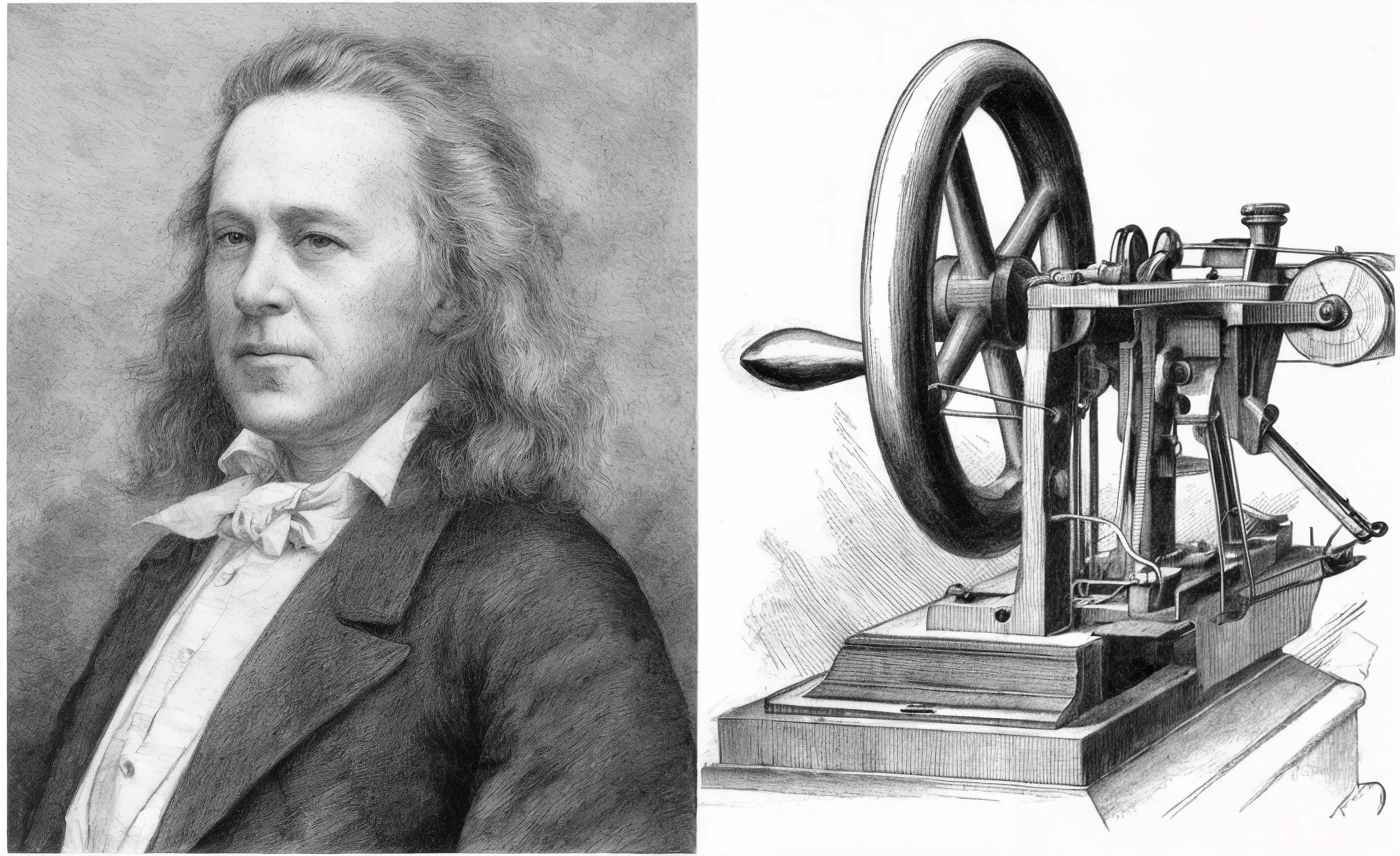
Elias Howe and his sewing machine.
Hire-purchase: how Clark invented consumer credit
Even with the patents settled, Singer machines had a problem. The price.
A sewing machine cost one hundred twenty-five dollars in 1856. The average American family income that year was about five hundred. Clark eventually pushed the price down toward one hundred — still beyond reach for the women he wanted to sell to. Reaching them required something the country didn't yet have.
So he invented it.
In 1856, Clark introduced the Singer hire-purchase plan: five dollars down, five dollars a month until the machine was paid off. Later iterations went further — one dollar a day, one dollar a week, custom rental terms for different income brackets. A farm wife in Iowa or Kansas could order the machine by mail, receive it within weeks, and pay for it in egg-and-butter money over a year. While she paid, the machine was already working. The Edward Clark Singer installment plan would, within a generation, become the template for how Americans bought everything.
Singer sold machines. Clark sold time.
Greed didn't invent capitalism. Patience and a payment book did.
The showroom on Broadway
Contemporary accounts of the Singer showrooms describe rooms that were marble-floored and gas-lit, with plate-glass windows that put the machines on display the way a jeweler displayed a ring. Behind a counter sat a young woman — most demonstrators were women, hired and salaried for the purpose — paid to do one thing well: stitch a hem on a piece of cambric while a customer watched.
The customer was almost always a woman too. She watched the needle rise and fall, felt the absence of her own three hours of finishing the seam by hand, and signed a contract for installment buying. Five dollars today. Five dollars a month. The machine in the cart, in the wagon, on the train, in her parlor by Friday.
Not a sale. A conversion experience.
A century and a half later, Apple would copy the mechanics — the lit glass, the demonstrator, the table, the trial — almost line by line.
Trade-in and the first retail chain
Clark followed the installment plan with what became the Singer trade-in: customers who already owned an old machine could surrender it as part-payment toward a new one. The surrendered machines were destroyed publicly to keep them off the secondary market — a piece of theatre Singer himself enjoyed staging.
Clark also rebuilt the sales channel itself. Independent dealers, who tended to sell whatever machine paid the highest commission that month, were replaced by exclusive Singer agents — trained, salaried, demonstrating the machine in showrooms or in customers' homes. By the late 1860s, Singer operated hundreds of branch offices across the United States. It was, effectively, the first global consumer-goods retail chain. Apple Stores were a hundred and fifty years away. Clark had already drawn the floor plan.
In its first decade Singer sold machines by the hundreds of thousands. By the late 1860s, the company was the largest sewing machine manufacturer in the world.
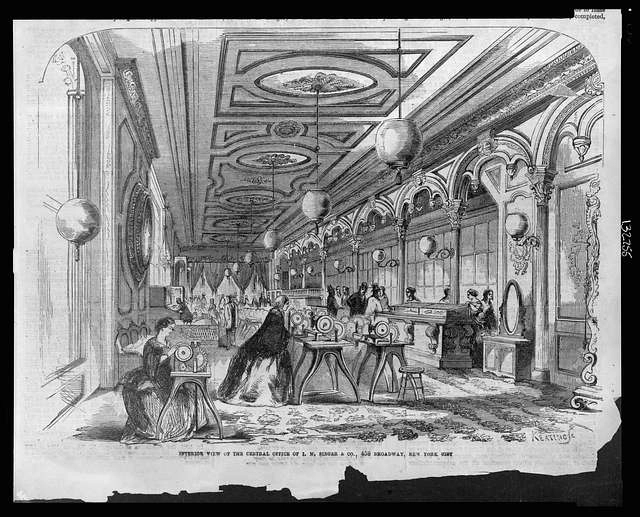
Interior view of the central office of I.M. Singer & Co., 458 Broadway, New York City
Managing the empire while the founder fled
The empire was growing. The brand was not safe.
By the early 1860s, Isaac Singer's private life had moved past eccentric into ruinous. On August 7, 1860 Mary Ann Sponsler, driving along Fifth Avenue in her own carriage, passed Singer in an open vehicle beside one Mary McGonigal. She screamed publicly until half the avenue stared; she then drove home to No. 14 Fifth Avenue, where Singer met her in a rage and administered what she later called "a brutal and bloody assault." The arrest, reported in Frank Leslie's Illustrated Newspaper (then read by 500,000 Americans), exposed four parallel households and approximately twenty-four children by five different women. The arrest warrants and the press coverage that followed were the kind that destroy consumer brands.
Clark, who taught Sunday school and whose own wife refused to receive Singer in their home, made the call that saved the company. He told his partner to leave the country.
Singer accepted. On 19 September 1860 he sailed from New York under the alias "J. W. Simmons and Lady" — his "Lady" being the nineteen-year-old sister of his mistress Mary McGonigal, Kate. He lived in London and then in Paris, where he met Isabella Eugénie Boyer, a young Frenchwoman married to a Mr. Summerville. She conceived Singer's child, obtained a divorce from her husband, and on 13 June 1863 married Singer in Manhattan, at the Church of St. John the Evangelist on Waverley Place — already heavily pregnant. By the early 1870s Singer had bought the Fernham estate at Paignton on the Devon coast and commissioned local architect George Bridgman to build him a vast house in the style of a "florid French villa." Singer called it The Wigwam — an Indian name for home. His son Paris Singer would later expand it into the 115-room Oldway Mansion. Isaac disappeared from American public life. He kept his ownership stake. He surrendered operational control.
Clark took it.
Building the first multinational
When I. M. Singer & Co. was reorganized as the Singer Manufacturing Company in 1863, the formal president was Inslee Hopper, a company accountant. The actual president was Edward Clark. He oversaw the construction of the Elizabethport, New Jersey factory in 1873, which would soon produce more sewing machines per year than any plant on earth. He opened the company's first overseas factory at Glasgow in 1867 and pushed branch operations into Hamburg (1863) and Montreal. He set the global standard for interchangeable parts in consumer machinery — a discipline borrowed from the U.S. Army Ordnance Department and applied, for the first time, to a domestic appliance.
When Singer died in England in 1875, Clark formally became president of Singer Manufacturing Company. He held the office for seven years, until his own death in 1882. By then, Singer was the first American multinational corporation in the modern sense — vertically integrated, internally financed, trading under a single brand on every inhabited continent.
The showman started the brand. The lawyer built the machine that outlived him.
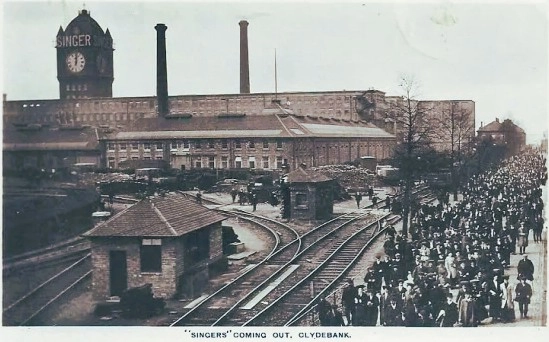
Singer Sewing Machine Factory Clydebank
The Dakota and the Clark legacy
Manhattan real estate was Clark's quieter obsession. By the 1870s he had bought parcels in upper Manhattan that anyone with a current sense of geography would have called a mistake. The Upper West Side in 1880 was a stretch of unfinished streets and squatter shacks, separated from polite New York by a long carriage ride.
Clark hired Henry Janeway Hardenbergh, a young New Brunswick–born architect with a feeling for European hotel architecture, and gave him the brief: a luxury apartment building so far north of the city that it might as well be in the Dakota Territory. The nickname stuck. The building became the Dakota.
Construction began in October 1880. The total cost ran past a million dollars, an unprecedented sum for residential construction. Clark died on October 14, 1882, of malarial fever at his country estate near Cooperstown. The Dakota opened to its first tenants in 1884. Ninety-six years after that, on the night of December 8, 1980, John Lennon was shot to death at its main entrance. The building has been continuously occupied since opening.
In his will, Clark bequeathed fifty thousand dollars to Williams College — used to build Clark Hall, still in use. He left two hundred fifty thousand dollars to each of his four grandsons, plus the Dakota itself to twelve-year-old Edward Severin Clark. The bulk of the residual estate — between twenty-five and fifty million dollars, the equivalent of roughly eight hundred million to one and a half billion in today's money — went to his only surviving son, Alfred Corning Clark.
Cooperstown and the Clark dynasty
Alfred's sons turned Singer wealth into American culture. Stephen C. Clark and Sterling Clark became two of the most important art collectors in the United States. Stephen donated the family land in Cooperstown that became the National Baseball Hall of Fame in 1939. Sterling's collection of French Impressionists became the Clark Art Institute in Williamstown — built on the same hill where his grandfather had studied a century earlier.
The sewing machine paid for the museum that bought the Renoirs.
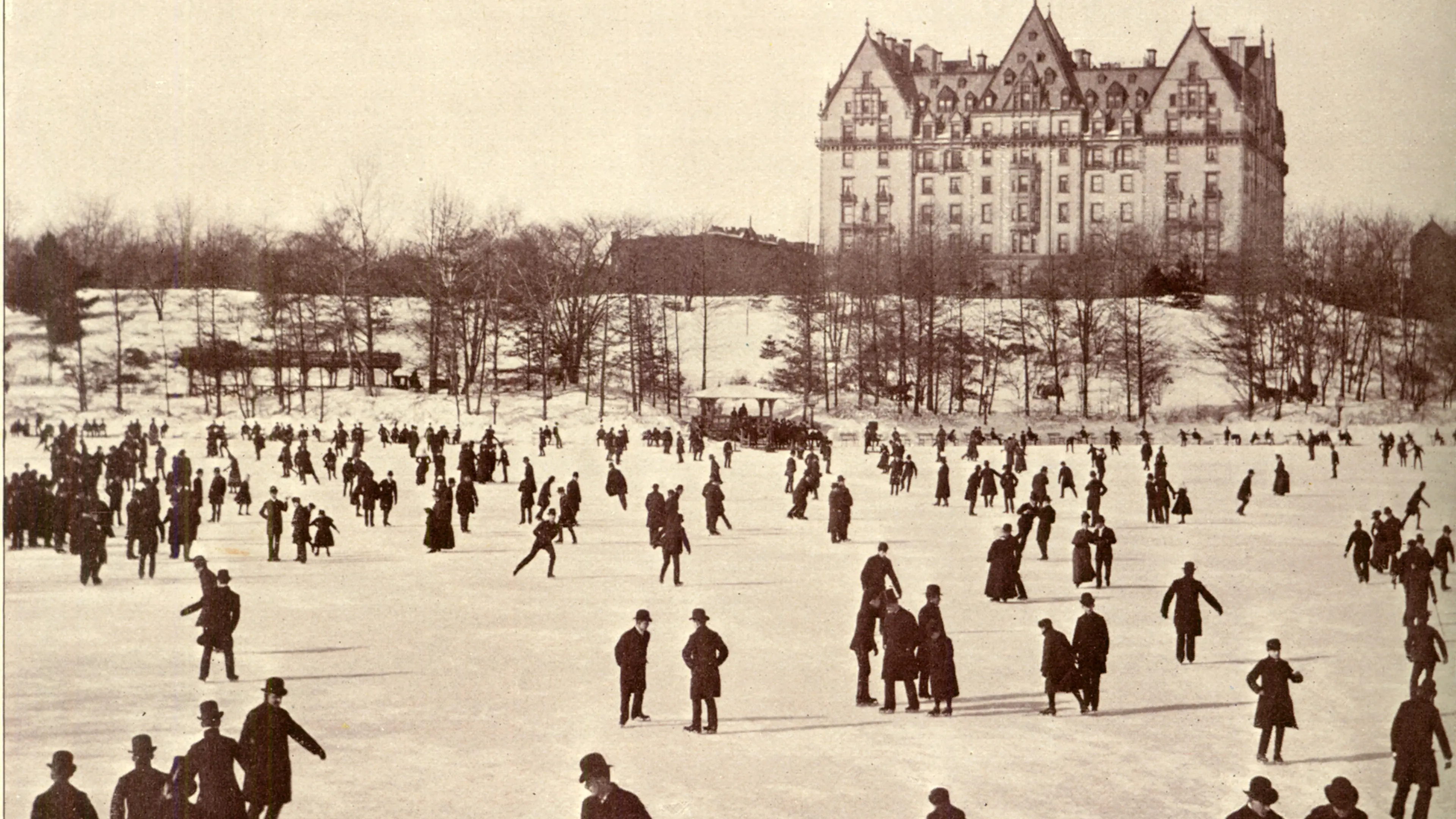
Skaters on the lake in Central Park. The Dakota dominated the scene.
Why Edward Clark was forgotten
History does not remember the architects of systems. It remembers faces.
Singer had a face. He had four parallel households, twenty-four children by five women, a yellow carriage, an English country mansion called The Wigwam, and a habit of getting his name into the New York Herald. He was the brand. He performed it.
Clark performed nothing. He was a Williams College lawyer, a Sunday school teacher, a man who came home for dinner. He worked sixteen hours a day in a Manhattan office, said little, and produced almost no quotable material. His personal correspondence, when historians went looking after his death, was thin. He left a few business letters and a will.
He didn't put his face on the machine because he understood, correctly, that no woman in Iowa would buy a sewing machine endorsed by a New York lawyer. The brand needed a maker. Singer was an excellent maker.
What Clark left behind is harder to see because it has no emblem. It is the structure of the modern consumer economy — paying for things in installments, walking into a branded showroom, expecting the brand to behave the same in Tokyo as in Boston, settling patent disputes through licensing rather than war. Most of us have never thought about it. All of us live inside it.
A man who builds the stage is forgotten more easily than the actor on it. He should not be.
Edward Clark today: the prototype of the operating partner
If Edward Clark walked into a venture capital meeting in 2026, he would be hired before lunch. He is the prototype of the operating partner — the person who joins the founder and translates vision into structure. To Clark, patents were artillery. Licenses were treaties. He understood that distribution beats invention. He understood that brand discipline matters more than founder genius.
He understood, above all, that founders sometimes need to be removed from their own companies. Not fired. Sent to Europe. Quietly rendered absent. Kept on the cap table, off the front page.
Singer's tech-bro descendants — the founders who keep getting moved sideways by the boards their own success summoned — are walking a path Clark surveyed in 1856. The ground is the ground he leveled.
Clark didn't change the world by being seen.
He changed it by understanding what almost no one in 1856 understood: that the future of capitalism was not the machine. It was the machine plus the payment plan plus the showroom plus the brand. The partnership of Edward Clark and Singer was the laboratory where the consumer credit system of the twentieth century was first written down.
He sat in a back office on Nassau Street and quietly invented the twenty-first century.
What the fee became
Clark's half of the company outlasted every man who signed for it. His son Alfred died in 1896 and left a thirty-million-dollar trust to his widow and four sons.
Robert Sterling Clark put part of his share into a foundation in 1952 that is still making grants in New York today. His brother Stephen was already funding Cooperstown. The two of them spent forty years refusing to speak to each other.
Singer's own half scattered across some twenty children, but one share of it outlived the rest. His daughter Winnaretta turned hers into the Fondation Singer-Polignac, created in Paris in 1928 to fund the arts and the sciences. It has been running out of her own house near the Trocadéro since her death in 1943, and it is running still.
Two partners who could barely stand to share a room. Both fortunes still working, a century and a half later.
Frequently asked questions
Who was Edward Clark?
Edward Cabot Clark (1811–1882) was the Manhattan lawyer who became Isaac Singer's partner and turned the Singer Manufacturing Company into the world's first great multinational.
What did Edward Clark invent?
He pioneered the installment plan — "Five Dollars a Month" — in American retail, and engineered the first patent pool in U.S. industry, the Sewing Machine Combination.
Did Edward Clark build the Dakota?
Yes — he commissioned the Dakota apartment building on Central Park West in New York. He died in 1882, before it was completed in 1884.
How did Edward Clark meet Isaac Singer?
In 1851 Singer came to Clark's law firm unable to pay to defend his patent. Clark took the case for an equal third of the business instead of a fee, and ended up with half of it once the patent issued that August.
How rich was Edward Clark?
At his death in 1882 his estate was estimated at twenty-five to fifty million dollars — roughly double Isaac Singer's.
Sources
- Ruth Brandon, Singer and the Sewing Machine (1977).
- Edward Clark's diaries; Singer Manufacturing Company records.
Read more
The Hungry Wolf in a Golden Muzzle: Who Was Isaac Singer? — runaway apprentice, failed Shakespearean actor, bigamist who ran four parallel households and fathered approximately twenty-four children by five women — the "scoundrel" who perfected the sewing machine and changed the world.
The Scoundrel's Daughter: Winnaretta Singer — the inventor's daughter who spent the sewing-machine fortune on Stravinsky, Satie and Marie Curie, and turned the "scoundrel's" name into the music of the 20th century.
About Singer Series — the project behind these essays, including the forthcoming book and series.
Subscribe to the Singer Series and receive the first chapter of SINGER: The Scoundrel Who Changed the World free before publication. Get the chapter 1