

For most of the 1800s the question a court asked about a beaten wife was not whether a husband had struck her. It was where.
Behind a closed door, the law mostly shrugged. A married woman, in the eyes of English and American law, was not quite a separate person. Her property, her earnings, her legal voice — all folded into her husband's. So did her body. The leading legal authority of the age held that a man could "correct" his wife the way he corrected a child or a servant, and judges built a whole doctrine on top of that idea: not a license to maim, but a quiet permission to discipline, provided the marks did not show and the neighbors did not talk.
That second condition turned out to be the real law. Society's only firm rule was discretion. Keep it private, keep it modest, and the law would politely look the other way. The wife who suffered in silence was respectable. The wife who screamed in the street was a scandal.
Which is exactly why the story of Isaac Merritt Singer — the sewing-machine king whose product was sold as the great liberator of women — matters here. He broke the only rule that the system actually enforced.
Key facts
- Under coverture, a married woman had no separate legal identity; her property, earnings, and legal standing merged into her husband's.
- William Blackstone's Commentaries described a husband's power to "correct" his wife as he might a child, so long as he left no permanent injury — courts called it "moderate chastisement."
- Legal scholar Reva Siegel named the 19th-century shift "the rule of love": courts increasingly treated marital violence as a private matter and refused to intervene, making privacy the abuser's shield.
- The famous "rule of thumb" — a stick no thicker than a thumb — is a myth, not a real legal doctrine.
- Isaac Merritt Singer (1811–1875) ran four parallel households and fathered approximately twenty-four children by five women — Catharine Haley (legal first wife), Mary Ann Sponsler (common-law), Mary Eastwood Walters (mistress, "Mrs. Merritt"), Mary McGonigal (mistress, "Mrs. Mathews"), and Isabella Boyer Summerville (final wife).
- On August 7, 1860, Mary Ann caught him riding through Manhattan with Mary McGonigal; she screamed publicly on Fifth Avenue, then drove home to No. 14, where Singer beat her in a "brutal and bloody assault" (her words). The arrest was reported in Frank Leslie's Illustrated Newspaper and his secret life exposed.
- The privacy rule protected Singer for years — until Mary Ann stopped staying silent.
A husband's right to "correct" his wife
Start with the legal furniture, because none of what follows makes sense without it.
The doctrine was called coverture, and it ran through English common law and into American courts. When a woman married, her legal self was, in the language of the time, "covered" by her husband's. She could not own property in her own name, could not keep her wages, could not sign a contract, could not sue on her own. Two people, one legal person — and that person was him.
William Blackstone, whose Commentaries on the Laws of England was the textbook every English-speaking lawyer of the era grew up on, laid it out plainly. A husband, he wrote, might give his wife "moderate correction," the same authority he held over his children and servants, so long as he stopped short of permanent injury. The phrasing was almost domestic. Correction. As if a grown woman were a wayward pupil.
Courts picked up the language and softened it further. The term of art became "moderate chastisement" — a husband's recognized power to discipline his wife physically, within limits. The limits were the point of pride: this was framed as restraint, not cruelty. A civilized man corrected; a brute maimed. The law claimed to police the difference.
Two people became one legal person in marriage. That person was the husband.
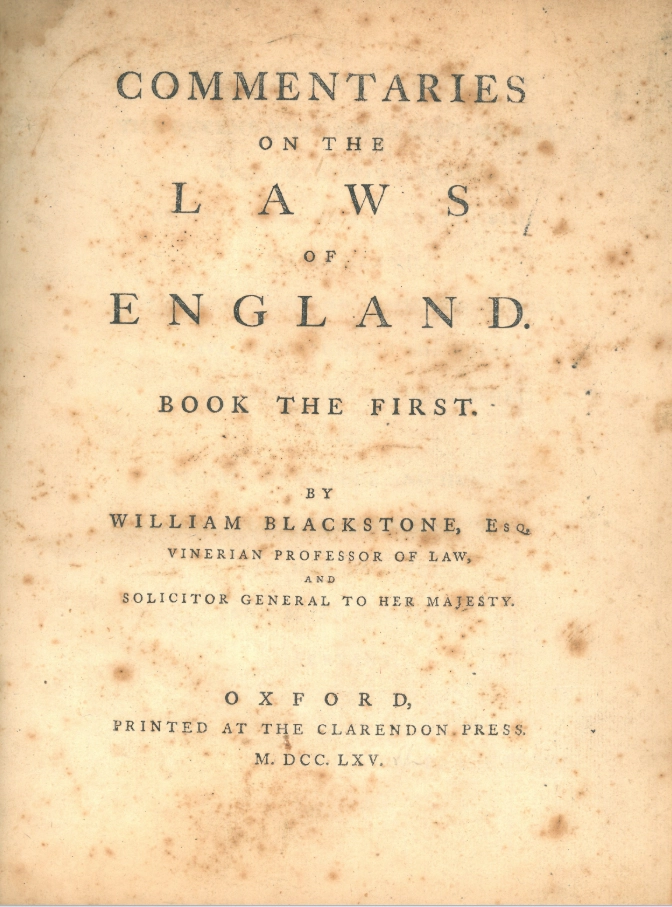
William Blackstone's Commentaries — the text that defined "moderate correction."
What the law did not do was treat a wife's body as her own. That single fact — her merged, covered, dependent legal self — is the soil everything else grew in.
The rule of love: privacy as the shield
Here is where the story gets quietly sinister, because the law did not simply stay brutal. It grew gentler in its words and harder in its effect.
Over the 19th century, American courts began to back away from openly endorsing a husband's right to strike his wife. The old language of "chastisement" started to embarrass them. But they did not replace it with protection. They replaced it with privacy.
The legal historian Reva Siegel gave this shift its name in a landmark study: the rule of love. Instead of declaring that a man may beat his wife, courts increasingly declared that what happened inside a marriage was a private family affair — too delicate, too intimate for a courtroom to meddle in. Judges wrote about marital harmony, about the sanctity of the home, about the wisdom of drawing a curtain over domestic quarrels. The result was the same beating, now wrapped in the warm vocabulary of love and family peace.

The private home the law refused to enter.
From permission to non-intervention
The move was subtle and it mattered enormously. A court that says "a husband may correct his wife" can be argued against, shamed, reformed. A court that says "we do not interfere in the privacy of the home" has built something harder to attack — because it sounds like respect.
The old law said a man could beat his wife. The new doctrine simply said the courtroom would not look.
Privacy, in other words, became the abuser's shield. The very value that protects an ordinary family from a meddling state was bent into cover for the man with bruised knuckles. A wife who went to the law might be told, in effect, that her suffering was a household matter and the household's to settle. The door that should have opened onto justice was instead pointed at, and called sacred.
The silence that made it work
A shield only works if people agree to hold it up. And in the 19th century, an entire culture held it up — not the law alone, but the servants, the neighbors, the family, the church, the woman herself.
Respectability was the currency. A household kept its standing as long as its troubles stayed behind its own walls. Servants who heard things downstairs learned not to repeat them. Relatives counseled patience. A bruise could be explained by a fall, a closed door by a headache. The community's deepest instinct was not to rescue the wife but to preserve the appearance — and the wife, dependent on that household for food and shelter and the legitimacy of her children, often had every reason to help preserve it too.
This is the part that modern readers tend to misremember, and a popular myth has made the misremembering worse.
The myth of the "rule of thumb"
You have probably heard that an old law let a man beat his wife with a stick "no thicker than his thumb" — and that this is where the phrase rule of thumb comes from. It is a tidy, infuriating story. It is also false.
No such statute existed. Historians have looked, and the supposed legal origin of "rule of thumb" does not hold up; the phrase comes from rough-and-ready practical measurement, not from a wife-beating code. The myth survives because it feels true to the era — and that is precisely why it deserves correcting. The reality was worse in a quieter way. There was no neat measuring stick, no clean legal limit a man could be caught exceeding. There was a vague standard of "moderation," a culture of silence, and a court system increasingly willing to call the whole thing private. No ruler. Just a closed door.
The horror was not a measured stick. It was the absence of any measure at all, behind a door no one would open.
So the system ran on silence. And it ran well, for a long time, because the people most able to break the silence — the victims — had the most to lose by breaking it.
Isaac Singer: the man who forgot the rule
Now bring on the man who is supposed to be the hero of women's history, and watch the irony close like a trap.
Isaac Merritt Singer was a showman before he was an industrialist — an actor, a tinkerer, a salesman with enormous appetite and almost no restraint. Working with the lawyer Edward Clark, he turned an improved sewing machine into one of the first great consumer empires of the modern age. The machine that bore his name was marketed, genuinely and successfully, as a gift to women: it collapsed the brutal hours of hand-sewing, put a tool of independence into millions of homes, and let women earn.
His private life was the exact negative of that image. Over his lifetime Singer fathered approximately twenty-four children by five women — and, at the peak in 1860, ran four parallel households simultaneously, each kept hidden from the others. In two of them he lived under assumed names: "Mr. Mathews" for Mary McGonigal's family at No. 70 Christopher Street, and "Mr. Merritt" for Mary Eastwood Walters and her daughter Alice in Brooklyn. He was, in plain terms, a serial bigamist — running his domestic life with the same disregard for rules that built his fortune.
One of those households belonged to Mary Ann Sponsler. For years she lived as "Mrs. Singer," and was the mother of roughly ten of his children. She had been with him through the lean years and the rise. And by her own later testimony, given under oath in court, those years had included beatings — repeated violence in which, she said, he had struck and choked her "to insensibility."

Isaac Merritt Singer (1811–1875).
The machine that freed millions of women from the needle could not free a single woman in his own house.
That is the man. A public benefactor of women, a private tyrant to the ones nearest him. For most husbands of the era, the rule of love would have kept all of this safely out of sight. Singer was about to violate the one condition the system demanded.
August 7, 1860
The break came on a summer day in Manhattan, when one of Singer's hidden households collided with another in broad daylight.
On August 7, 1860, Mary Ann saw Isaac riding down Fifth Avenue with another woman, Mary McGonigal, whom he also kept as a wife. She confronted him in the open, in the middle of the avenue, in front of anyone who cared to look.
What came next was the kind of violence the privacy doctrine existed to bury. Back at the house, Singer beat her — and when their daughter Voulettie tried to intervene, he struck her too, by Mary Ann's later account beating her to insensibility. But this time the rule did not hold. Mary Ann refused to keep it behind the door: she had him arrested, and the scandal reached the press, reported in Frank Leslie's Illustrated Newspaper.

Fifth Avenue looking north from 28th Street in New York City
For years the rule had held because she stayed silent. It broke the moment she refused to.
That refusal is the hinge of the entire story. The doctrine of privacy had no power over a woman who would not keep the secret. Once Mary Ann spoke, the shield was useless — because the violence was already in the newspapers and the courtroom, out in the public air where the law could no longer pretend not to see.
The silence breaks: bigamy exposed, arrest, flight
The arrest itself was bad. What it dragged into the light was catastrophic for him.
Once the scandal cracked the surface, the rest came pouring out. Singer was not a respectable husband who had lost his temper. He was a man running four parallel households, a string of women and children kept hidden from one another, each believing in some version of a life he had no intention of honoring. The arrest put his name in the press; the press put his secret architecture on display. The benefactor of women stood exposed as a serial bigamist who beat the women he kept.
He did what powerful men with money have always done when the ground opens under them. He left — sailing from New York in September 1860. He lived in London and Paris, where he met Isabella Eugénie Boyer and married her, in Manhattan, on 13 June 1863; only afterward did he settle in England, far from the New York courts and the New York papers, building himself a grand house at Paignton, in Devon. (Its vast, palace-like form came later: his son Paris rebuilt the estate into a Versailles-by-the-sea years after Isaac's death.) He arranged his late life with all the comfort his fortune could buy.
The man escaped. The pattern he had relied on did not survive contact with a victim who talked. That is the lesson hiding inside his flight: the rule of love protected him perfectly right up until the day it didn't, and what ended it was not a reforming judge or a new statute. It was one woman declining to be quiet.

Flight: rather than face the New York courts, Singer sailed for England.
The reckoning
Isaac Singer died in 1875, rich beyond the dreams of the runaway apprentice he had once been, leaving an estate of between thirteen and fifteen million dollars, distributed across multiple wills (the first drawn up in Paris on 16 July 1870). He used part of it to settle old scores. To his eldest son William — born in 1834 to Catharine Haley, the first wife Isaac had abandoned in the 1830s, and who had sided with his mother in her countersuit of 1863 — he left five hundred dollars outright. To William's sister Lillian, ten thousand. To Mary Ann Sponsler — his common-law wife of two decades, by then long remarried to a man named John E. Foster — nothing at all. Revenge from the grave, written into the will of a dying millionaire.
Sit with the central irony, because it is the whole point. The Singer machine is one of history's genuine instruments of women's emancipation. It put earning power and independence into the hands of millions of women who had been chained to the needle. And the man who built it could not, or would not, extend that freedom to a single woman under his own roof. He freed the world's seamstresses and beat the mother of his children.
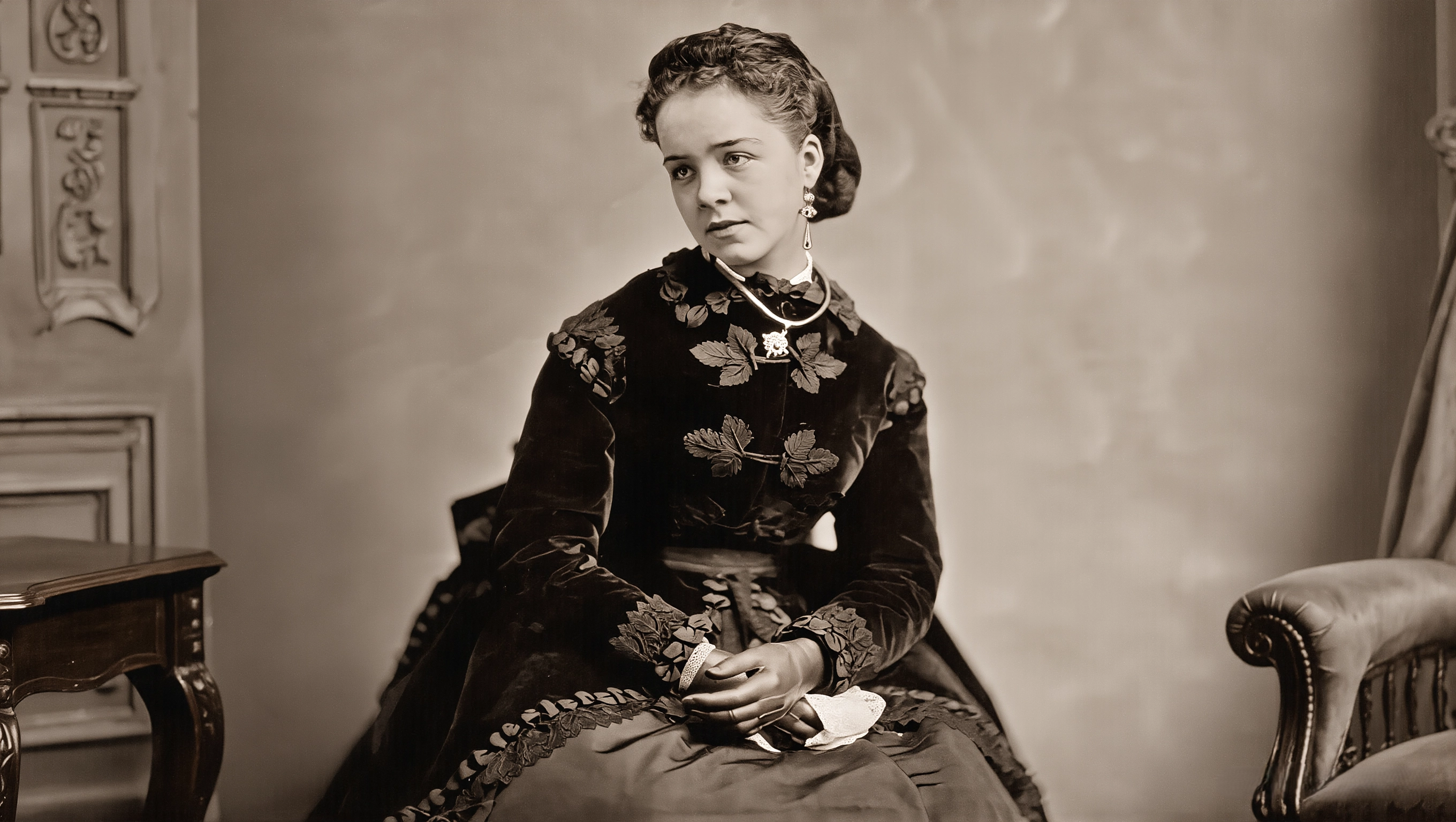
A woman of the era, c. 1860.
He liberated women he would never meet, and terrorized the ones he knew.
And the rule of love held for him as long as it holds for any abuser: as long as the victim stays silent. It was not the law that finally moved against Isaac Singer. The law was, if anything, his ally — coverture, "moderate chastisement," the soothing doctrine of domestic privacy. What broke him was Mary Ann Sponsler walking into the open and refusing to pretend. That is why this history is not a museum piece. The shield he hid behind — it's private, it's a family matter, don't make a scene — is still raised today, every time someone is told to keep it quiet for the sake of appearances.
There is one more thread, and it belongs to the book rather than to the documented record on this page. The story explored in SINGER: The Scoundrel Who Changed the World suggests that the public scandal was not the first time — that, a year before, after a beating, Mary Ann had once gone away for several days to let the bruises fade so that no one would see. Whether and how that fits the larger picture is the kind of thread the book pulls. What the record here makes plain is simpler and harder: the rule worked through silence, and it died the day a woman stopped being silent.
Frequently asked questions
Was it actually legal for a husband to beat his wife in the 19th century?
In effect, within limits, for much of the period — yes. Under coverture a wife had no separate legal identity, and Blackstone's influential Commentaries described a husband's right to give his wife "moderate correction" so long as he caused no permanent injury. Courts spoke of "moderate chastisement." Later in the century, courts shifted from openly permitting violence to simply declining to intervene in what they called private family matters — which protected abusers just as effectively.
What does "the rule of love" mean?
It is the term the legal scholar Reva Siegel used for a 19th-century shift in how courts handled marital violence. Rather than affirming a husband's right to strike his wife, courts increasingly reclassified domestic abuse as a private family matter and refused to get involved, citing marital harmony and the sanctity of the home. The language grew loving; the protection for victims did not. Privacy became the abuser's shield.
Is the "rule of thumb" — beating a wife with a stick no thicker than a thumb — a real law?
No. It is a persistent myth. No such statute existed, and historians have found no genuine legal origin for the phrase along these lines. The reality was in some ways worse: there was no clear measurable limit at all, only a vague standard of "moderation" and a culture, increasingly backed by the courts, of treating the whole matter as private.
Who was Mary Ann Sponsler?
She was Isaac Singer's common-law wife, who lived for years as "Mrs. Singer" and was the mother of roughly ten of his children. By her own later court testimony, she had endured repeated beatings over the years. On August 7, 1860, after a public confrontation that ended with him beating her at home, she went to the authorities rather than hide it — the act that exposed his secret life.
What happened on August 7, 1860?
Mary Ann saw Isaac riding down Fifth Avenue with another woman, Mary McGonigal, whom he also kept as a wife, and confronted him publicly. Afterward, at the house, he beat her severely and also struck their daughter Voulettie when she tried to intervene. This time Mary Ann did not keep it quiet: she had him arrested, and the case reached the press, including Frank Leslie's Illustrated Newspaper.
What happened to Isaac Singer after the scandal?
The public arrest cracked open his hidden life — four parallel households and a string of women and children kept from one another. On 19 September 1860 Singer sailed from New York under the alias "J. W. Simmons and Lady", his "Lady" being the nineteen-year-old sister of his mistress Mary McGonigal. He lived in London and Paris, then settled at Paignton in Devon, where local architect George Bridgman built him a grand house called The Wigwam (later enlarged by his son Paris into the 115-room Oldway Mansion). In Manhattan on 13 June 1863 he married Isabella Eugénie Boyer Summerville — she had just divorced her first husband and was already pregnant with their first child. He died in 1875 leaving between thirteen and fifteen million dollars in multiple wills; to his eldest son William — son of his abandoned first wife Catharine Haley — he left just $500. To Mary Ann Sponsler, his common-law wife of two decades, nothing.
Sources
- Reva B. Siegel, "The Rule of Love: Wife Beating as Prerogative and Privacy," Yale Law Journal (1996).
- William Blackstone, Commentaries on the Laws of England.
- Frank Leslie's Illustrated Newspaper and the New York press, 1860.
- Ruth Brandon, Singer and the Sewing Machine (1977).
Read more
The Hungry Wolf in a Golden Muzzle: Who Was Isaac Singer? — the showman, the bigamist, the genius who built an empire and ran from the scandal that exposed it.
Edward Clark: The Lawyer Who Built the Singer Empire — the quiet partner who turned Singer's chaos into the world's first global consumer brand. The man behind the Dakota.
The Scoundrel's Daughter: Winnaretta Singer — how Singer's sewing-machine money bought the music of the 20th century.
Subscribe to the Singer Series and receive the first chapter of SINGER: The Scoundrel Who Changed the World free before publication. Get the chapter 1
If you or someone you know is affected by domestic abuse, support is available. In the US, the National Domestic Violence Hotline is at 1-800-799-7233 or thehotline.org.
In the UK, call Refuge on 0808 2000 247; elsewhere, contact your local domestic-abuse service.