

July 23, 1875. Paignton, on the south coast of Devon. In a bedroom chosen because it faces south — he feels the cold badly — a man of sixty-three is dying with the window full of scaffolding. The palace outside is not finished. It will never be finished, not for him.
The dying man is Isaac Singer, and he has spent a lifetime being shown the door: from his father's table at twelve, from the society of Yonkers, from the drawing rooms of the English gentry. The stage never threw him out — it simply never filled the seats. Every audience he ever wanted eventually looked away.
So he has prepared one last performance that no one can walk out of. His own funeral — cast, costumed, and directed by the deceased.
A big wigwam
A doctor sent the Singers to Devon: after Franklin's birth, Isabella's health was delicate, and the mild sea air of Torquay was the standard prescription. Singer liked the place, bought the Fernham estate in neighboring Paignton, and hired a young local architect named George Bridgman to build him something no second-hand house could be.
About the name there was never any doubt. "I want a big wigwam," he declared, "and I shall name it The Wigwam." His son William explained it years later: their father, wherever he happened to be, "never for a moment failed to claim and insist… that he was an American citizen" — so his Devon home got "an Indian name for home."
The patriotism stopped at the name. In design, the architect's daughter remembered, the house was to be "as far as possible in the style of a rather florid French villa" — with its own private theater, a riding school and arena, conservatories, and every modern fitting on the market. Singer supplemented the plans with his own sketches and sent Bridgman to France to take notes. He bought up some twenty cottages and gardens around the estate; one lady in a key position refused to sell, and the uninterrupted sea view escaped him.
On May 10, 1873, Isabella laid the foundation stone.
A failed actor had finally built himself a theater. Now he needed an audience.
The ball, bought and paid for
He had tried to earn an audience before. When Singer finished his first palace — The Castle, in Yonkers, New York — he threw a housewarming party. A newspaper reporter recorded the result: "Hundreds were invited. Few went."
Devon repeated the experiment with better manners and the same verdict. "He tried to get into society by giving a grand ball, to which all the aristocracy of the neighbourhood were invited," a local paper wrote. "But they mercilessly snubbed him, and in revenge he asked all the tradesmen of the place, and gave them an entertainment the like of which for magnificence has hardly ever been seen in England."
That became the pattern. Three days a year were his: Christmas, when several hundredweight of meat and provisions went to the poor of the district; the Fourth of July, when the American gave his party; and his birthday in October, when the children got their treats.
The gentry had a society he could not enter. So he built one that would not refuse.
Nine days
His heart had been weak for years. In May 1875 he caught a chill; the doctors called it "an affection of the heart and inflammation of the wind-pipe." The best medical advice money could summon was sent for: Sir William Jenner came down from London. Singer did not improve.
His favorite daughter Alice was to be married in June. The wedding was postponed for her father's illness, then held on July 14 in spite of it; Alice was given away by David Hawley, Singer's trusted American lawyer, a friend from the unhappy Yonkers days. Singer planned the festivities himself — a party to outdo all his previous parties — and most of Paignton and Torquay were invited.
He did something else on July 14. While the house was full of wedding guests, he signed his final will.
The marriage lasted little more than a week; the groom took ship for America. What her father thought of that we will never know. Nine days after the wedding, on July 23, 1875, Isaac Singer was dead — without ever seeing his great house finished. "The last party," Ruth Brandon writes, "had obviously been too much for him."
The funeral, directed by the deceased
He had left detailed instructions — Brandon calls it "the staging of his final role" — and Mr. Oliver of Union Street, the undertaker, can rarely have supervised anything like it.
The body was dressed "in the American style": black coat and trousers, white satin waistcoat, white gloves, black slippers. It went into three coffins, one inside another — cedarwood lined with white satin, with a white satin mattress and pillow trimmed with Maltese lace; then lead "of unusual thickness"; then English oak, grained and paneled, with silver handles.
His own twelve horses drew the funeral car, three abreast. The sides of the car were removed — his instruction — so that the outer coffin would be visible to everyone along the road.
Two thousand people came. Behind the four mourning coaches, a local paper reported:
came Mr Singer's carriage, with blinds drawn, and drawn by two splendid bay horses. This was followed by carriages containing the men and women servants employed at Oldway, and behind them walked four deep, about 50 men who worked on the estate… The principal establishments at Torquay and Paignton were partially closed, flags lowered to half mast, and at the latter town the church bell was tolled. The funeral procession was nearly three-quarters of a mile long, and contained between seventy and eighty carriages.
His own carriage with the blinds drawn. The visible coffin. The staff on foot, four abreast, like a chorus exiting upstage. Every seat in the house was full, and for once nobody left early.
For his whole life the audiences walked out. This one lined the road for three-quarters of a mile.
Brandon's verdict stands as the review: "He had without doubt staged one of the best funerals of his day."
The town had no room for him
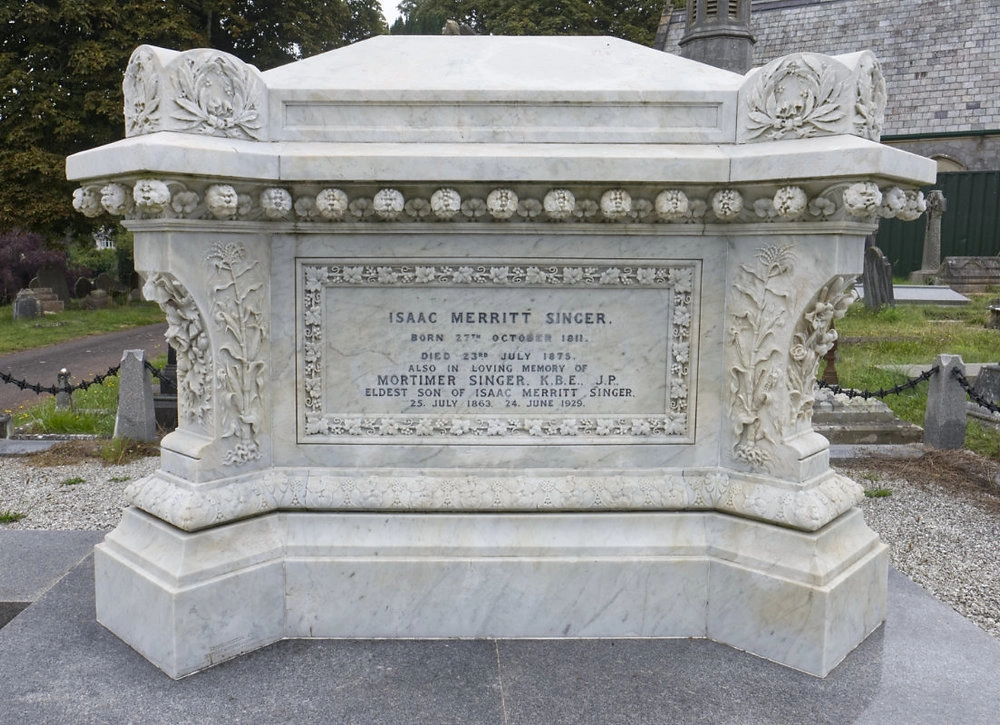
One correction to the script came after the curtain. The family wanted Singer buried at Paignton — the town he fed at Christmas, whose church bell tolled for him. The planned mausoleum took up so much space that the cemetery had to refuse. The monument was erected at Torquay instead.
The reason was bureaucratic — the tomb would not fit. The irony survived it anyway. Even in the ground, Paignton had no room for him.
Sixty equal parts, and three lines that were not equal
The estate came to between thirteen and fifteen million dollars — one of the great American fortunes of its day. The paperwork came in layers: a will drawn in Paris on July 16, 1870, an English settlement, and the final document of July 14, 1875, folding everything into one.
The arithmetic was almost democratic. After small bequests, the fortune was cut into sixty equal parts — $10,043.18 in cash and $121,975 in stock, each — and distributed among the members of four of his families, named side by side in one list, legitimate and illegitimate alike; the children of his hidden families entered under the surname he chose for them in the text itself: Singer. As a will, it was tidy. As a public document, it was a confession no court could ignore.
Three lines broke the symmetry.
To his eldest son William — who had taken his mother's side in her countersuit of 1863 — no place in the list at all. No share of the sixty. A flat five hundred dollars, handed past the division. Out of thirteen million.
To his daughter Voulettie — nothing, with the reason written into the will: through her father's appointment her husband had obtained his position in the Singer Manufacturing Company, "and has thus acquired a fortune which places my daughter above the necessity of any assistance from me." Her wedding, thirteen years earlier, was the last time he needed to be generous with her.
To Mary Ann, who had lived more than twenty years as Mrs. Singer and borne him ten children — nothing at all.
And one line nobody contested: Mary McGonigal, mother of five heirs on that list, was allotted $5,000 a year for herself. She never touched the money.
Mary Ann sued. For a month, in a surrogate's court at White Plains — before a judge whose actual name was Coffin — Singer's private life was recited in public one last time, through the daily press, into every drawing room in New York and eventually Devonshire. Surrogate Coffin ruled her claim "undoubtedly without foundation": Isabella was the legal widow. The New York Herald closed the file with the phrase Ruth Brandon would one day borrow for a chapter title: the decision, it wrote, removed from public view "a very ghastly domestic story."
He left thirteen million dollars and not one family. To the son who defended his mother — five hundred. To the horses — a parade.
What the wigwam became
The family scattered the way his money did — outward, and strangely upward. Isabella took the children to Paris. Paris Singer, the son, later bought out his brothers' shares in the house and rebuilt it on the model of Versailles — today's Oldway Mansion — before going on to bankroll Isadora Duncan and develop Palm Beach. Winnaretta became Princesse de Polignac and turned her share of the fortune into the music of the twentieth century: Stravinsky, Satie, a foundation that funds science to this day.
The house still stands in Paignton. The gardens are open to anyone who walks in — the one audience policy its builder never tried.
A century and a half before founders learned to curate their own legends, Singer wrote, cast, and directed his — and exited to a full house.
SINGER: The Scoundrel Who Changed the World is out on August 12, 2026 — the day his patent No. 8294 turns one hundred and seventy-five. The story of how the runaway in the rain got to Devon begins with chapter one. It is free.
Key facts
- Isaac Merritt Singer died on July 23, 1875, at his unfinished Paignton estate, nine days after his daughter Alice's wedding — and nine days after signing his final will.
- The house was named The Wigwam — in his son's words, "an Indian name for home"; it was designed by local architect George Bridgman as "a rather florid French villa," with a private theater, riding arena and conservatories.
- The funeral followed his own written instructions: three coffins (cedar, lead "of unusual thickness," English oak with silver), the body dressed "in the American style," the funeral car drawn by his own twelve horses, three abreast, with the sides removed so the coffin stayed visible.
- Two thousand people attended; the procession ran nearly three-quarters of a mile and included seventy to eighty carriages; shops partially closed and flags flew at half-mast in Torquay and Paignton.
- Paignton cemetery could not accommodate the planned mausoleum; Singer was buried at Torquay.
- The estate — $13–15 million — was divided into sixty equal parts among four of his families. His eldest son William was left out of the division entirely and received $500 outright; his daughter Voulettie and Mary Ann Sponsler, nothing.
- Mary Ann contested the will before Surrogate Coffin at White Plains; Isabella Boyer Singer was ruled the legal widow.
Frequently asked questions
Where did Isaac Singer die?
At his estate in Paignton, Devon, England, on July 23, 1875 — in the mansion he called The Wigwam, still under construction. He was sixty-three.
What was The Wigwam?
Singer's last house: a palace on the Fernham estate at Paignton, designed by George Bridgman to Singer's own sketches as a "florid French villa" with a private theater and riding arena. His son Paris later rebuilt it in Versailles style; it is known today as Oldway Mansion.
How big was Isaac Singer's funeral?
By his own posthumous instructions: three nested coffins, twelve of his own horses three abreast, a visible coffin on an open car, four mourning coaches, some fifty estate workers on foot — a procession of seventy to eighty carriages, nearly three-quarters of a mile long, before two thousand people.
How much did Singer leave, and to whom?
Between $13 and $15 million, split into sixty equal parts among four of his families. The exceptions were deliberate: his eldest son William was excluded from the division and handed $500 outright, his daughter Voulettie received nothing, and Mary Ann Sponsler — his common-law wife of more than twenty years — nothing at all.
What happened to the house?
Paris Singer rebuilt it on the model of Versailles; as Oldway Mansion it still stands in Paignton, and its gardens are open to the public.
Sources
- Ruth Brandon, Singer and the Sewing Machine: A Capitalist Romance (1977) · Torquay and Paignton local press, July 1875 · recollections of the architect's daughter (Mrs. Laura Goss) · Singer will case records, Surrogate's Court, White Plains, 1875 · New York Herald, 1875.
Read more
Edward Clark: The Lawyer Who Built the Singer Empire — the quiet partner who turned Singer's chaos into the world's first global consumer brand. The man behind the Dakota.
The Hungry Wolf in a Golden Muzzle: Who Was Isaac Singer? — runaway apprentice, failed Shakespearean actor, bigamist with five families and twenty-four children — the "scoundrel" who perfected the sewing machine and changed the world.
Winnaretta Singer: The Scoundrel's Daughter — the inventor's daughter who spent the sewing-machine fortune on Stravinsky, Satie and Marie Curie, and turned the "scoundrel's" name into the music of the 20th century.
About Singer Series — the book, the series, the film. One story. Three formats.
Subscribe to the Singer Series and receive the first chapter of SINGER: The Scoundrel Who Changed the World free before publication. Get the chapter 1